
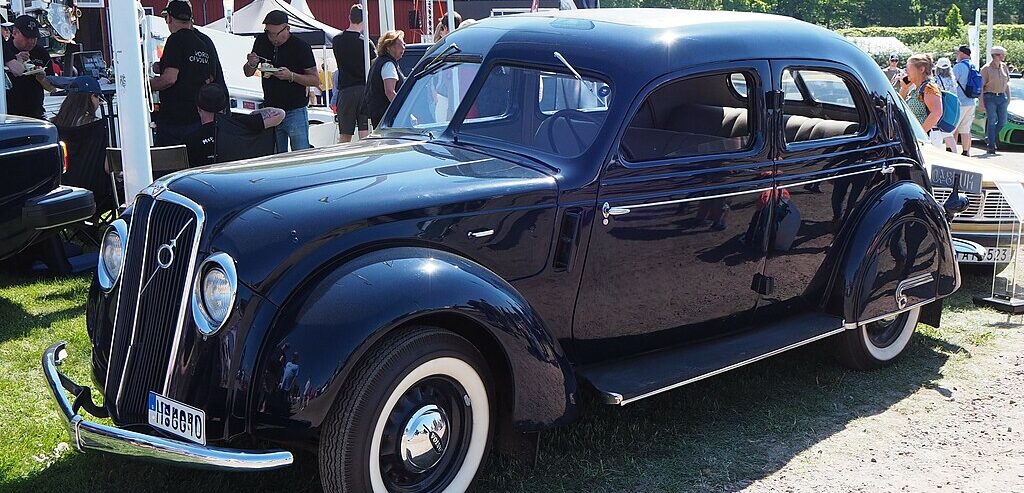
Volvo PV36 Carioca – Swedish Art Deco Classic of the 1930s
The Volvo PV36 Carioca is one of the most fascinating and visually striking automobiles ever produced by the Swedish manufacturer. With its boldly streamlined body, avant-garde proportions, and refined engineering, this rare machine represented a defining moment in Volvo’s history — a moment when the company dared to look far beyond the conservative tastes of its home market and embraced the future with remarkable confidence. As a Volvo enthusiast who has spent over two decades studying these vehicles, I can say without hesitation: the PV36 Carioca deserves far more recognition than it typically receives.
What Is the Volvo PV36 Carioca?
The Volvo PV36 Carioca is a full-sized, streamlined saloon car produced by AB Volvo in Gothenburg, Sweden, between 1935 and 1938. It was one of the earliest European automobiles to fully embrace the aerodynamic design philosophy that was sweeping through the global automotive industry during the mid-1930s. With only 500 units ever produced, the PV36 is today an exceptionally rare collector’s car — a true automotive artefact from the Art Deco era.
Its unusual name is itself a story worth telling. “Carioca” refers both to the inhabitants of Rio de Janeiro and to a lively Brazilian dance that became fashionable in Europe during the 1930s. Volvo chose this exotic, cosmopolitan name deliberately, positioning the PV36 as something extraordinary — a vehicle that embodied elegance, movement, and modernity all at once.
When Was the Volvo PV36 Carioca Built? – Production Facts at a Glance
The PV36 was manufactured over a relatively short production window, which directly contributes to its rarity and desirability among collectors today.
| Detail | Information |
|---|---|
| Production years | 1935 – 1938 |
| Total units produced | Approximately 500 |
| Body style | 4-door streamlined saloon |
| Manufacturer | AB Volvo, Gothenburg, Sweden |
| Market segment | Upper middle-class / premium |
The very limited production run — just 500 cars across three model years — was not a sign of failure so much as a reflection of market realities. The PV36’s radical appearance simply outpaced what Swedish buyers were prepared to accept at the time. Nevertheless, it laid essential groundwork for Volvo’s design identity in the decades that followed.
The History of the Volvo PV36 Carioca
To truly appreciate the PV36, you need to understand the era in which it was born. The 1930s were a decade of dramatic transformation in automotive design worldwide. Engineers and stylists — particularly in the United States — had begun to understand that the boxy, upright carriages of the previous generation were not only aesthetically outdated but also aerodynamically inefficient. The new ideal was the streamlined form: smooth, curved, and flowing, as though shaped by the wind itself.
This philosophy found its most celebrated expression in the Chrysler Airflow, launched in 1934 — a car that sent shockwaves through the industry. Volvo’s leadership observed these developments closely and made the bold decision to introduce a comparably progressive vehicle for the Swedish and export markets. The result was the PV36 Carioca, unveiled at the 1935 Stockholm Motor Show to considerable public attention.
The reception was, to put it diplomatically, mixed. Swedish buyers of the mid-1930s tended toward traditional tastes, and the Carioca’s dramatically rounded silhouette, integrated headlamps, and curved window surrounds struck many as simply too unconventional. Despite enthusiastic press coverage and genuine admiration from forward-thinking observers, sales remained modest throughout the car’s production life. If you are interested in exploring this fascinating period of automotive history in greater depth, a dedicated book on Volvo’s classic car heritage makes an excellent starting point.
When production ended in 1938, the PV36 was replaced by more conventional-looking Volvo models. Yet history has been kind to the Carioca. What was once seen as too radical is now celebrated as visionary, and surviving examples command serious respect — and serious prices — at international classic car auctions.
Who Designed the Volvo PV36 Carioca?
The design of the PV36 was led by Ivan Örnberg, a Swedish engineer who had previously worked at Ford’s facilities in the United States. This transatlantic experience proved decisive: Örnberg returned to Sweden with a thorough understanding of American streamlining trends and a clear vision for what a modern Volvo could look like.
Under his direction, the PV36 adopted a number of genuinely advanced design elements for its time:
- A fully integrated, pontoon-style body with smooth, unbroken lines from nose to tail
- Recessed, faired-in headlamps blended into the front wings — a stark departure from the free-standing headlamp pods of contemporary competitors
- A steeply raked windscreen and curved glass all around, reducing aerodynamic drag
- A long, tapering rear end inspired by contemporary aircraft and locomotive design
- Integrated running boards that flowed naturally into the lower body panels
The primary stylistic influence was unmistakably the Chrysler Airflow, though Örnberg and his team developed a distinctly European interpretation — somewhat more restrained and elegant than the American original. The result was a car that looked simultaneously exotic and purposeful, and which holds up remarkably well aesthetically even by today’s standards.
Volvo PV36 Carioca – Technical Specifications
Beneath its revolutionary exterior, the PV36 relied on a proven and robust mechanical foundation. Volvo was, at its core, an engineering-led company, and the Carioca reflected that priority — combining visual innovation with dependable, real-world performance.
| Specification | Details |
|---|---|
| Engine type | Inline 6-cylinder, side-valve (OHV) |
| Engine displacement | 3,670 cc (3.67 litres) |
| Power output | Approx. 86 hp (PS) at 3,600 rpm |
| Gearbox | 3-speed manual transmission |
| Chassis | Separate ladder-frame chassis |
| Suspension (front) | Independent, transverse leaf spring |
| Suspension (rear) | Rigid axle with semi-elliptic springs |
| Brakes | Four-wheel hydraulic drum brakes |
| Top speed | Approx. 120 km/h (75 mph) |
| Kerb weight | Approx. 1,550 kg |
The six-cylinder engine was, in essence, a refined evolution of the powerplant already used in Volvo’s larger saloons of the era. While it was not a high-performance unit by modern standards, it offered smooth, torque-rich power delivery that suited the car’s grand touring character admirably. The independent front suspension — still relatively uncommon in European cars of this period — gave the PV36 a noticeably more composed and comfortable ride than many of its contemporaries.
The four-wheel hydraulic braking system was another forward-thinking feature, offering far superior stopping power compared to the mechanical brake systems still found on many rival vehicles. In short, while the PV36 may have looked like a concept car, it was engineered to be a reliable, usable automobile.
Interior and Equipment
The interior of the Volvo PV36 Carioca matched its exterior ambition. Volvo positioned the car firmly in the upper-middle-class segment, and the cabin reflected this with materials and fittings that were notably upmarket for a Swedish production car of the 1930s.
- Generous seating for five passengers across two rows
- High-quality upholstery in cloth or leather, depending on specification
- A full-width wooden dashboard with integrated instrumentation
- A column-mounted gear lever — advanced for the period
- Good interior headroom aided by the car’s tall, curved roofline
By the standards of mid-1930s Sweden, this was a genuinely luxurious motor car. It was aimed at business professionals, doctors, senior officials, and others who required both a degree of prestige and practical everyday usability.
The Volvo PV36 Carioca as a Collector’s Car
Today, surviving examples of the Volvo PV36 Carioca are among the most prized vehicles in any serious Scandinavian classic car collection. Given that only around 500 were built — and that a number have been lost to time, accidents, or neglect over the past nine decades — the number of remaining cars is genuinely small. Restored examples in excellent condition have appeared at major European auction houses, where they consistently attract strong bidding from collectors with a deep appreciation for pre-war automotive design.
What makes the PV36 particularly special from a collector’s perspective is the combination of its historical significance, its visual drama, and its direct connection to a pivotal chapter in Volvo’s corporate story. It is not simply a rare old car — it is a rolling manifesto for a design philosophy that was decades ahead of its time. For those who wish to add a scale model of this extraordinary vehicle to their collection, a diecast model of the Volvo PV36 Carioca is a wonderful way to celebrate this piece of motoring history.
The PV36 Carioca in the Context of Volvo’s Design History
It would be a mistake to view the PV36 Carioca in isolation. It is, in fact, a critical link in a continuous chain of design evolution that runs through Volvo’s entire history. The lessons learned from the Carioca — about aerodynamics, integrated body styling, and the importance of interior comfort — directly influenced the design of subsequent models, including the highly successful Volvo PV444 of 1944, which went on to become one of the best-selling Swedish cars of the postwar era.
In this sense, the PV36 was not a dead end but a catalyst. Its commercial modesty should not obscure its intellectual and engineering legacy. Many of the ideas that Ivan Örnberg and his team pioneered with the Carioca became mainstream Swedish automotive design principles within just a few years. If you want to explore the full breadth of Volvo’s remarkable design and engineering heritage, a comprehensive book on Volvo classic cars will give you the complete picture.
Frequently Asked Questions About the Volvo PV36 Carioca
What does “Carioca” mean in the context of this Volvo model?
“Carioca” is a term used to describe a native or resident of Rio de Janeiro, Brazil. It is also the name of a popular Latin dance that became fashionable in Europe during the 1930s. Volvo chose this name to evoke a sense of exoticism, elegance, and modernity — qualities the company wanted to associate with its groundbreaking new streamlined saloon.
How many Volvo PV36 Carioca cars were produced?
A total of approximately 500 Volvo PV36 Carioca units were produced between 1935 and 1938. This very limited production run makes surviving examples exceptionally rare and highly sought after by collectors of pre-war European automobiles.
What engine did the Volvo PV36 use?
The PV36 was powered by a 3,670 cc inline six-cylinder engine producing approximately 86 horsepower at 3,600 rpm. This was a refined development of the six-cylinder unit already used in Volvo’s larger saloon cars of the period, offering reliable and smooth power delivery well-suited to the car’s touring character.
Who designed the Volvo PV36 Carioca?
The PV36 was designed under the leadership of Ivan Örnberg, a Swedish engineer with significant experience at Ford in the United States. Örnberg drew strong inspiration from American streamlining trends, most notably the Chrysler Airflow of 1934, and created a distinctly European interpretation of the aerodynamic design philosophy.
Why were sales of the Volvo PV36 Carioca so low?
The PV36’s radical, forward-looking design was simply too unconventional for many Swedish buyers of the mid-1930s, who tended to prefer more traditional automotive styling. The car was genuinely ahead of its time aesthetically, and while it attracted considerable press admiration, converting that interest into sales proved difficult in a conservative home market.
Is the Volvo PV36 Carioca related to the later Volvo PV444?
Yes, indirectly but significantly. The design and engineering lessons learned during the development and production of the PV36 Carioca directly informed the direction of subsequent Volvo models. The PV444, introduced in 1944 and enormously successful in the postwar period, can be seen as a spiritual descendant of the PV36’s streamlined philosophy — refined, domesticated, and made commercially viable for a mass market.
Where can I see a Volvo PV36 Carioca today?
A small number of preserved and restored Volvo PV36 Carioca examples can be found in Scandinavian automotive museums and private collections. The Volvo Museum in Gothenburg, Sweden, is the best starting point for anyone wishing to experience Volvo’s pre-war heritage firsthand. Occasionally, examples appear at major European classic car shows and auctions, where they invariably attract significant attention.
Conclusion: A Visionary Car That Was Simply Born Too Early
The Volvo PV36 Carioca stands as one of the most important and underappreciated automobiles in European pre-war history. It was a car that demanded the world catch up with it rather than meeting convention halfway. In an era when caution was commercially rewarded, Volvo chose boldness — and while the market did not immediately respond, history has delivered the ultimate verdict in the Carioca’s favour.
For collectors, historians, and enthusiasts of classic Scandinavian automobiles, the PV36 represents something precious: evidence that Volvo was never simply a manufacturer of reliable, sensible transport. From its earliest years, there was a creative and progressive spirit at work in Gothenburg — one that would go on to produce some of the most iconic and influential cars of the twentieth century. The Carioca was where that spirit first found its most complete, most dramatic, and most beautiful expression.
Comments
Leave a Comment