
Volvo Milestones: Key Moments in Volvo’s History
Volvo Milestones: The Key Moments That Shaped a Swedish Legend
Few automotive brands carry the same weight of history, engineering integrity, and passionate ownership culture as Volvo. Over nearly a century, the Swedish manufacturer has produced vehicles that have become cultural touchstones — from the rugged durability of the Amazon to the iconic lines of the P1800. As someone who has spent more than 40 years turning wrenches on classic Volvos, I can tell you that understanding these Volvo milestones is not just an academic exercise. It is the foundation for truly appreciating every bolt, every weld, and every design decision you encounter when you restore or maintain one of these magnificent machines.
In this article, we will walk through the most important moments in Volvo’s history — the engineering breakthroughs, the design revolutions, and the cultural turning points that transformed a small Swedish company into a globally respected automobile manufacturer. Whether you are a first-time enthusiast or a seasoned collector, this timeline of Volvo milestones will deepen your appreciation for the cars in your garage.
The Birth of Volvo: 1927 and the ÖV4
The story begins on April 14, 1927, when the first Volvo rolled off the assembly line in Gothenburg, Sweden. That car was the ÖV4, affectionately known as “Jakob.” Built to withstand the harsh Scandinavian climate and notoriously rough Swedish roads, the ÖV4 was a car designed with a clear philosophy: safety, durability, and reliability above all else. This philosophy has never changed, and if you have ever driven a well-preserved early Volvo, you can feel it in the solidity of the bodywork and the confidence the car inspires on the road.
The ÖV4 was powered by a four-cylinder engine producing around 28 horsepower — modest by any standard, but this was 1927. More importantly, Volvo co-founders Assar Gabrielsson and Gustaf Larson established a production mindset rooted in quality over volume. That founding discipline echoes through every classic Volvo I have ever restored.
If you are interested in diving deeper into the early chapters of Volvo’s story, I highly recommend picking up a comprehensive Volvo history book. Browse Volvo history books on Amazon — they make an excellent companion for any enthusiast’s bookshelf.
Major Volvo Milestones: A Timeline Overview
To give you a clear picture of how Volvo evolved decade by decade, here is a structured overview of the most significant Volvo milestones in automotive history:
| Year | Milestone | Significance |
|---|---|---|
| 1927 | First Volvo ÖV4 “Jakob” produced | Founding of the brand; durability-first philosophy established |
| 1944 | Volvo PV444 introduced | First modern unibody Volvo; post-war design revolution |
| 1956 | Volvo Amazon (P120) launched | Iconic styling; became backbone of classic Volvo culture |
| 1959 | Three-point seatbelt introduced by Volvo | Greatest automotive safety invention of the 20th century |
| 1961 | Volvo P1800 sports car debut | Design icon; global recognition; still beloved by collectors |
| 1966 | Volvo 140 Series launched | Broader market appeal; refined engineering standards |
| 1974 | Volvo 240 Series introduced | One of the best-selling and most durable Volvos ever made |
| 1991 | Volvo 850 launched | Front-wheel drive revolution; modern era begins |
| 1999 | Ford Motor Company acquires Volvo Cars | Major ownership shift; global expansion accelerated |
| 2010 | Geely acquires Volvo Cars from Ford | New chapter; renewed investment in engineering |
| 2019 | Volvo commits to full electrification | Brand repositions as future-facing, sustainability-driven |
The Three-Point Seatbelt: Volvo’s Greatest Gift to Humanity
Without question, the single most important of all Volvo milestones is the invention and free licensing of the three-point seatbelt in 1959. Engineer Nils Bohlin developed the diagonal-and-lap belt system while working at Volvo, and in a decision that remains extraordinary to this day, Volvo made the patent available to all other car manufacturers at no cost. The company understood that safety was more important than competitive advantage.
It is estimated that the three-point seatbelt has saved over one million lives since its introduction. As someone who has worked on classic Volvos for decades, I have personally seen the results of Volvo’s safety engineering in restored Amazons and early 140 series cars that absorbed impacts in ways that lesser-built vehicles simply could not. The structural integrity built into these cars is not accidental — it is a direct legacy of that 1959 breakthrough moment.
[Link to related article: Volvo Safety History Explained]
The Volvo Amazon and P1800: Design Icons of the 1950s and 1960s
The Amazon (P120): Built for Real Roads
When the Volvo Amazon was introduced in 1956, it was a revelation. The P120 featured clean, flowing lines influenced by American styling trends of the era, yet it retained a distinctly Scandinavian practicality. I have restored several Amazons over the years, and what always strikes me is the quality of the steel used in these bodies — thick, well-formed panels that, when properly cared for, resist the passage of time far better than many contemporaries.
The Amazon was also the first car in the world to come fitted with a three-point seatbelt as standard equipment — another Volvo milestone in itself. Production ran from 1956 to 1970, and during that time, the Amazon earned a loyal following across Scandinavia, Europe, and North America. Today, a well-preserved or properly restored Amazon is one of the most desirable classic Volvos on the market.
[Link to related article: Restoring a Volvo Amazon: A Complete Guide]
The P1800: Volvo’s Sports Car Legend
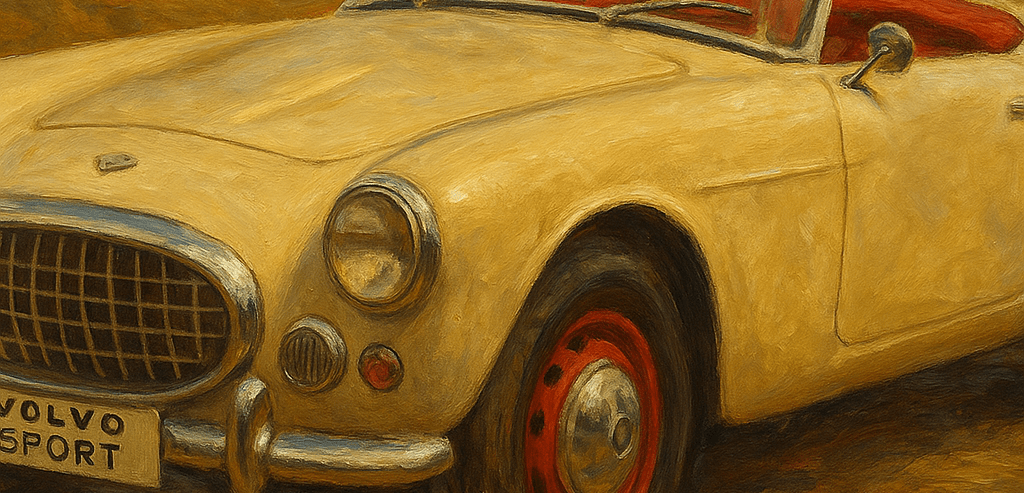
The P1800 is, in my personal opinion, one of the most beautiful cars ever produced — not just by Volvo, but by anyone. Introduced in 1961 and famously driven by Roger Moore in the television series “The Saint,” the P1800 gave Volvo an international glamour that the practical Amazon never quite achieved. Yet beneath the stunning coachwork was the same Volvo engineering DNA: robust, reliable, and built to last.
I once worked on a 1966 P1800 that had covered nearly 250,000 miles on its original engine with relatively minor maintenance. That kind of longevity is not luck — it is engineering philosophy made tangible. The P1800 remained in production until 1973, evolving through several variants including the practical P1800ES estate. Diecast models of the P1800 remain popular collectibles today. Find Volvo P1800 diecast models on Amazon if you want to display a piece of this history.
The Volvo 240: The Indestructible Workhorse
No discussion of Volvo milestones would be complete without a dedicated section on the 240 Series. Introduced in 1974 and produced until 1993, the Volvo 240 became a cultural phenomenon — particularly in North America, where it became synonymous with safety-conscious, practical motoring. The boxy, upright design was never fashionable in a traditional sense, but it was brilliantly functional.
The 240’s longevity as a model is itself a milestone. Nearly two decades of production with continuous refinement rather than dramatic reinvention is a statement of confidence in the underlying design. I have driven and maintained dozens of 240s over the years. They respond to proper maintenance with extraordinary loyalty — keep the engine fed with good oil, address the rust early, and a 240 will simply keep going.
- Over 2.8 million units produced during its production run
- Available as sedan, estate (wagon), and coupe variants
- Consistently ranked among the most reliable cars of its era
- Still actively used and collected by enthusiasts worldwide
- One of the safest cars of its generation according to crash data
[Link to related article: Buying a Classic Volvo 240 – What to Look For]
The 1990s Transition: From the 700 Series to the 850
The Volvo 700 series of the 1980s — particularly the 740 and 760 — continued the conservative engineering tradition while introducing more sophisticated turbocharged engines and improved interior comfort. These cars represent an important bridge between the golden era of classic Volvos and the modern period. The 760 GLE and turbocharged 740 variants are increasingly sought after by youngtimer collectors.
Then came the 850 in 1991 — a genuine milestone for Volvo. The switch to a front-wheel-drive platform with a transversely mounted five-cylinder engine represented a fundamental departure from decades of rear-wheel-drive tradition. The 850 proved that Volvo could reinvent itself without abandoning its core values, and it went on to remarkable success in the British Touring Car Championship, providing unexpected motorsport credibility.
Volvo in the Modern Era: Electrification and Global Ownership
The acquisition of Volvo Cars by Ford in 1999 and subsequently by Chinese automaker Geely in 2010 raised many eyebrows in the classic Volvo community. From my perspective, the Geely era has actually been a period of genuine reinvestment. The development of the Scalable Product Architecture platform and the commitment to full electrification by 2030 represent bold strategic milestones that honor, rather than contradict, the brand’s founding values of safety and engineering integrity.
Volvo’s introduction of the XC90 in 2002 and its repositioning as a premium brand has created a new generation of Volvo enthusiasts who may eventually find their way back to the classics — and that is nothing but good news for those of us who have been tending these cars for decades.
Why Volvo Milestones Matter to Classic Car Enthusiasts
Understanding the historical context of the car you are restoring or driving changes everything about the experience. When I fit a new wiring loom to a 1960s Amazon, I am not just doing an electrical repair — I am participating in a lineage of craftsmanship that stretches back to Gothenburg in 1927. When I adjust the carburetors on a P1800, I am working on a car that helped put Swedish automotive engineering on the world map.
The Volvo milestones documented in this article are not merely corporate history. They are the story of a philosophy — a belief that cars should protect their occupants, last for decades, and reward careful ownership. That philosophy is alive every time a well-maintained classic Volvo fires up on a cold morning and settles into that distinctive idle.
For those who want to go deeper into the engineering details of maintaining and understanding classic Volvos, Volvo restoration and workshop manuals available on Amazon are an invaluable resource for any serious enthusiast.
Frequently Asked Questions About Volvo Milestones
What was the first car Volvo ever produced?
The first Volvo ever produced was the ÖV4, nicknamed “Jakob,” which rolled off the production line on April 14, 1927, in Gothenburg, Sweden. It was an open-top, four-cylinder vehicle designed specifically to handle the demanding conditions of Swedish roads and climate.
Who invented the three-point seatbelt and why is it a Volvo milestone?
The three-point seatbelt was invented by Volvo engineer Nils Bohlin and introduced in 1959. Volvo made the patent freely available to all manufacturers, prioritizing global road safety over commercial gain. It is widely considered the most life-saving automotive safety innovation in history.
What makes the Volvo Amazon historically significant?
The Volvo Amazon (P120), produced from 1956 to 1970, was the first car in the world to feature the three-point seatbelt as standard equipment. It also represented a major leap forward in design and build quality for Volvo, establishing the brand’s reputation in international markets.
How long was the Volvo 240 in production?
The Volvo 240 was in production from 1974 to 1993 — a remarkable 19-year run. During that time, over 2.8 million units were produced, making it one of the most successful and enduring models in Volvo’s history. It remains a popular classic car among collectors and daily drivers alike.
What was significant about the Volvo 850?
The Volvo 850, introduced in 1991, marked Volvo’s transition from rear-wheel drive to a front-wheel-drive platform. It featured a transversely mounted five-cylinder engine and went on to achieve considerable motorsport success in the British Touring Car Championship, enhancing Volvo’s performance credentials.
Who owns Volvo Cars today?
Volvo Cars is currently owned by Chinese automotive group Geely, which acquired the brand from Ford Motor Company in 2010. Under Geely’s ownership, Volvo has significantly expanded its product range and committed to a full electrification strategy by 2030.
What is the most collectible classic Volvo?
The Volvo P1800 is widely regarded as the most collectible and desirable classic Volvo, particularly among international collectors. The Amazon (P120) is a close second and arguably more attainable. Among youngtimer models, the 240 estate and the 780 coupe are gaining significant collector interest.
Comments
Leave a Comment