
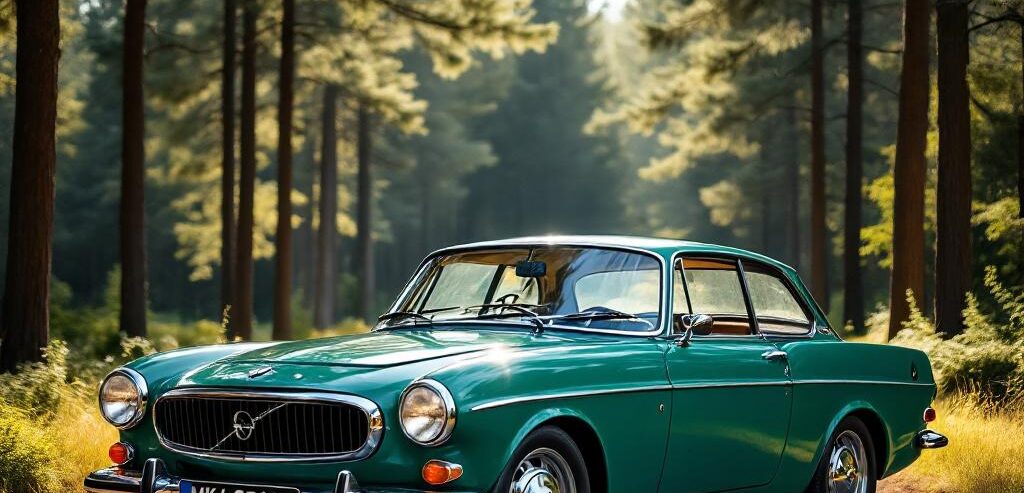
Volvo 144: The Swedish Classic – Complete Guide
Every time I stand in my workshop and take in the clean, uncluttered lines of a Volvo 144, the same feeling washes over me: this is a car that truly has something to say. No fashionable frills, no forced sportiness — just uncompromising Swedish engineering from the late 1960s and early 1970s at its very best. With more than 20 years spent restoring and maintaining classic Volvo vehicles across Europe, I can say with confidence that the 144 holds a uniquely special place in my collection and in automotive history alike. In this in-depth vehicle portrait, I will walk you through what makes this Swedish saloon so remarkable, what to look for when buying one today, and why the Volvo 144 deserves more attention than ever in the classic car world.
History of the Volvo 144 – The Birth of a Classic
The Volvo 144 made its world debut at the Paris Motor Show in September 1966, marking the beginning of an entirely new chapter for the Swedish manufacturer. It was the first model of the celebrated 140 Series, a lineup that Volvo produced until 1974 and that would become one of the most commercially and critically successful ranges in the brand’s long history. The model name was anything but accidental: the first digit identified the series, the second indicated the engine type (four-cylinder), and the third denoted the number of doors — four in the case of the 144 saloon.
The 144 was developed under the creative leadership of chief designer Jan Wilsgaard, who had previously shaped the iconic Volvo Amazon. With the 144, however, Wilsgaard pursued a radically different philosophy. Where the Amazon had embraced sweeping, American-influenced curves, the 144 adopted a crisp, box-like bodyshell with generous glazing and purposeful proportions. At first glance, the result appeared almost austere. Look again, and you begin to appreciate the quiet confidence of a design that prioritised integrity over trend-chasing — a hallmark of Swedish industrial thinking that resonates just as strongly today.
For readers who want to explore the full story behind this era of Volvo development, the Volvo 140 Series history books available on Amazon offer an excellent deep dive into the engineering and design decisions of the period.
Safety as a Brand Identity – Volvo Sets the Standard
What truly set the Volvo 144 apart from its contemporaries was its comprehensive approach to occupant safety — a philosophy that was, in 1966, nothing short of revolutionary. Volvo had already changed the world in 1959 when engineer Nils Bohlin introduced the three-point safety belt. With the 144, the company went considerably further, integrating a suite of passive and active safety features that competitors would not adopt for years, and in some cases, decades.
- Rigid passenger cell with engineered crumple zones front and rear
- Safety steering column designed to collapse progressively on impact
- Three-point seatbelts fitted as standard on all front seats
- Dual-circuit braking system with separate hydraulic circuits for front and rear axles
- Reinforced door structures providing lateral impact protection
- Padded interior surfaces and a recessed instrument panel to reduce injury risk
Nils Bohlin himself was still working at Volvo during the development of the 144, and his influence on the car’s safety architecture is unmistakable. In comparative crash evaluations of the era, the Volvo 144 consistently outperformed rivals from Germany, the United Kingdom, and the United States — a fact that attracted significant international press coverage and helped cement Volvo’s global reputation as the safety car manufacturer par excellence. This was not marketing spin; it was verifiable, measurable engineering leadership.
Technical Specifications – What’s Under the Bonnet
The Volvo 144 was offered with a range of four-cylinder engines throughout its production life, each sharing the same fundamental architecture of Volvo’s B-series powerplant family. These engines were renowned for their robustness, ease of maintenance, and longevity — qualities that remain deeply appreciated by classic car restorers like myself to this day.
| Engine | Displacement | Power Output | Years Offered |
|---|---|---|---|
| B18A | 1,778 cc | 75 hp (SAE) | 1966–1968 |
| B18B | 1,778 cc | 85 hp (SAE) | 1966–1968 |
| B20A | 1,986 cc | 82 hp (DIN) | 1969–1974 |
| B20B | 1,986 cc | 100 hp (DIN) | 1969–1974 |
| B20E (Fuel Injection) | 1,986 cc | 124 hp (DIN) | 1971–1974 |
The top-specification B20E engine, equipped with Bosch D-Jetronic fuel injection, was a genuinely impressive unit for its time and gave the 144E a vivid performance character that still surprises drivers encountering these cars for the first time. Transmission options included a four-speed manual gearbox and a Borg-Warner automatic, the latter being particularly common in Scandinavian and North American markets.
Suspension was conventional but well-engineered: independent front struts with coil springs and a live rear axle located by a Panhard rod and coil springs at the back. Disc brakes were fitted all round on higher-specification models — another safety-forward decision that was far from universal in the late 1960s.
The Volvo 144 in Production – Variants and Model Years
Over its eight-year production run from 1966 to 1974, the Volvo 144 received several meaningful updates while retaining its core character throughout. Understanding the differences between model years is essential knowledge for any prospective buyer or restorer.
- 1966–1968 (Series I): Original B18 engines, chrome-heavy exterior trim, round headlights, and a relatively spartan interior. These early cars are the most sought-after by purists.
- 1969–1970 (Series II): Introduction of the enlarged 2.0-litre B20 engine family, revised front grille, and improved interior ergonomics.
- 1971–1972 (Series III): Arrival of the fuel-injected B20E engine, updated dashboard design with improved safety padding, and revised rear light clusters.
- 1973–1974 (Series IV): Final refinements ahead of the introduction of the 240 Series. Larger bumpers on some markets to meet emerging US safety legislation, slightly revised interior trim.
Alongside the four-door 144 saloon, the 140 Series also encompassed the two-door 142 coupé and the 145 estate — the latter being arguably the most practical classic Volvo of the era and enormously popular in Sweden and across northern Europe to this day.
Buying a Volvo 144 Today – What to Look For
The Volvo 144 has enjoyed a steady increase in collector interest over the past decade, and well-preserved or expertly restored examples now command respectable prices at auction and in private sales. From my own experience inspecting and purchasing these cars across Europe, here are the critical areas to evaluate before committing to a purchase.
Bodywork and Rust Assessment
Like virtually all Scandinavian cars of its era, the Volvo 144 is susceptible to corrosion, and a thorough rust inspection is absolutely non-negotiable. The most vulnerable areas are:
- Sill panels and inner sills — often the first area to corrode and the most expensive to repair properly
- Front and rear floor sections, particularly around the jacking points
- Wheel arch lips and the lower edges of the front wings
- The battery tray area in the engine bay
- The spare wheel well in the boot floor
- Door bottoms and the lower sections of the A, B, and C pillars
Surface rust on bolt-on panels is manageable and should not be a deal-breaker. Structural rust in the sills, floor, or suspension mounting points is a very different matter and can render an otherwise attractive car prohibitively expensive to restore. Always bring a magnet, a torch, and ideally an experienced companion on any pre-purchase inspection.
Mechanical Inspection Points
The good news is that the B18 and B20 engines are among the most durable and straightforward four-cylinders ever produced. Parts availability remains excellent, and a knowledgeable independent mechanic can service these units without specialist equipment. Key mechanical areas to assess include:
- Engine oil condition and signs of head gasket failure (white emulsion under the oil cap, overheating history)
- Clutch operation and gearbox smoothness through all ratios
- Condition of the rear axle and differential — listen for whining or clunking under load
- Brake system integrity, including the condition of callipers, flexible hoses, and the dual-circuit master cylinder
- Steering box play — some free play is normal, but excessive looseness indicates wear
If you are seriously considering purchasing a 144 and want authoritative guidance on the mechanical details, I strongly recommend picking up one of the Volvo 144 restoration and workshop manuals available on Amazon, which provide invaluable technical reference material for both buyers and restorers.
Driving the Volvo 144 – The Classic Experience
Driving a well-sorted Volvo 144 is an experience that rewards patience and attentiveness. This is emphatically not a sports car, nor was it ever intended to be. What it offers instead is a sense of calm authority on the road — a solidity and directness that modern cars, with all their electronic assistance and artificial feedback, struggle to replicate. The steering is accurate and communicative by the standards of the era. The ride quality, particularly on later B20-engined cars with revised suspension settings, is genuinely impressive: firm enough to feel planted, yet supple enough to absorb poor road surfaces without harshness.
The fuel-injected 144E, in particular, pulls with genuine enthusiasm from around 3,000 rpm and can hold its own on modern roads with a degree of composure that surprises first-time drivers. Cruising at motorway speeds is entirely relaxed, and the cabin — solid, well-insulated, and ergonomically sensible — makes long-distance travel genuinely enjoyable.
The Volvo 144’s Legacy and Collector Value
The Volvo 144 laid the direct conceptual and commercial foundation for the enormously successful 240 Series, which remained in production until 1993 and became one of the longest-lived production cars in automotive history. The 144’s influence on Volvo’s DNA — its emphasis on safety, durability, and honest engineering — persists in the brand’s identity to this day.
From a collector’s perspective, the 144 represents outstanding value compared to German contemporaries of equivalent quality and historical significance. A well-restored example still costs considerably less than a comparable Mercedes W114 or BMW New Class saloon, yet offers an equally compelling ownership experience and arguably greater engineering integrity in the safety domain. As awareness of the model grows among a younger generation of classic car enthusiasts, that gap in values seems unlikely to persist for long.
For those who want to understand the full cultural and engineering context of this remarkable car, books on classic Volvo history and the 140 Series era make an excellent starting point and a worthwhile addition to any enthusiast’s library.
Frequently Asked Questions About the Volvo 144
What years was the Volvo 144 produced?
The Volvo 144 was produced from 1966 to 1974, spanning eight model years. It was introduced at the Paris Motor Show in September 1966 and was gradually replaced by the Volvo 240 Series, which entered production in 1974.
How many Volvo 144s were built?
Volvo produced approximately 1,000,000 vehicles across the entire 140 Series range (including the 142 two-door and 145 estate). The 144 four-door saloon was by far the most popular body style and accounted for the majority of total production.
Is the Volvo 144 reliable for everyday use?
A properly maintained Volvo 144 is entirely capable of regular use. The B18 and B20 engines are exceptionally robust, spare parts are widely available from specialist suppliers across Europe and North America, and the overall mechanical architecture is straightforward enough for competent home mechanics to service. That said, like any classic car over 50 years old, it requires regular attention and a degree of patience.
What is the difference between the Volvo 144 and the 145?
The Volvo 144 is a four-door saloon (sedan), while the Volvo 145 is the estate (station wagon) variant of the same 140 Series platform. They share the same mechanical underpinnings, engines, and safety features but differ in body style. The 145 estate is particularly popular among families and collectors who value practicality.
What engine options are available in the Volvo 144?
The Volvo 144 was offered with several variants of the B-series four-cylinder engine: the 1.8-litre B18 in early cars (1966–1968), followed by the 2.0-litre B20 family from 1969 onward. The top specification was the fuel-injected B20E, producing 124 hp (DIN) and available from 1971 to 1974, which gave the 144E a notably livelier performance character.
How much does a Volvo 144 cost to buy today?
Prices vary considerably depending on condition, specification, and provenance. Unrestored but running project cars can be found from around €3,000–€6,000 in Europe. Solid, well-maintained drivers typically sell in the €7,000–€14,000 range, while concours-quality restorations or particularly original low-mileage examples can exceed €18,000–€22,000 at specialist auctions. Values have risen steadily over the past five years and are expected to continue appreciating.
Why is the Volvo 144 significant in automotive safety history?
The Volvo 144 was one of the first production cars in the world to integrate a comprehensive passive safety system as standard equipment. It combined a rigid passenger safety cell with engineered crumple zones, a collapsible steering column, standard three-point seatbelts, dual-circuit braking, and reinforced door structures — features that are now legally mandated globally but were entirely voluntary innovations when Volvo introduced them in 1966. This makes the 144 a genuinely important milestone in the history of automotive safety engineering.
Comments
Leave a Comment