
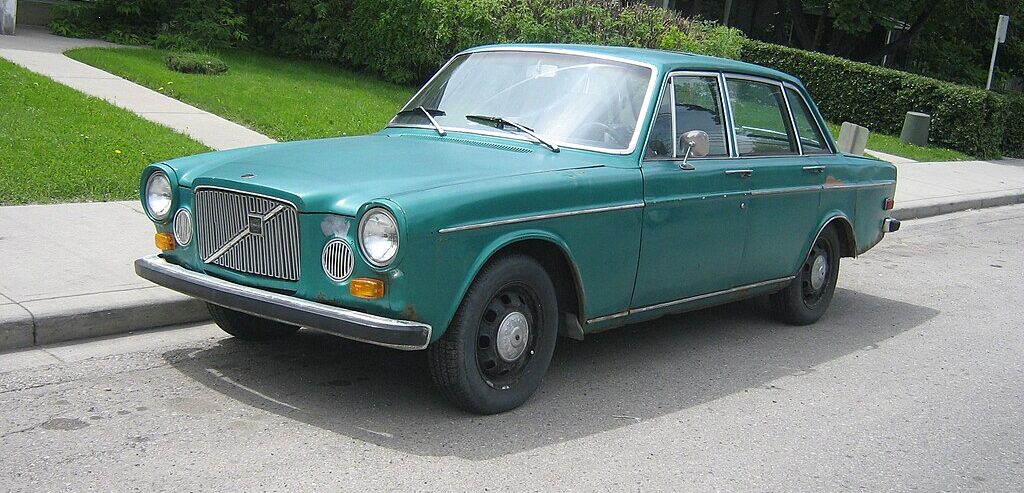
Volvo 164 (1968–1975): The Swedish Six-Cylinder Classic
Volvo 164 (1968–1975): Swedish Six-Cylinder Comfort and Style
The Volvo 164 holds a very special place in Scandinavian automotive history. It was Volvo’s first six-cylinder luxury model since the 1950s — a confident, elegantly styled upper-middle-class saloon that seamlessly combined genuine comfort, refined performance, and the hallmark Volvo safety standards that had already earned the brand global respect. Produced between 1968 and 1975, the 164 was the sophisticated, understated choice for discerning drivers who wanted something more prestigious than a standard family car, without resorting to German or British alternatives. Today, it stands as one of the most charismatic and collectible Swedish classics of the postwar era.
History of the Volvo 164
When Volvo unveiled the 164 at the Paris Motor Show in September 1968, it signalled a deliberate and ambitious step upmarket. Volvo’s management had long recognised that the brand’s excellent reputation for durability and safety could support an entry into the executive segment — a market dominated at the time by Mercedes-Benz, Jaguar, and the early BMW 6-series. The 164 was Volvo’s answer to that challenge.
The model was built upon the proven and robust Volvo 140 series platform, which had been carefully stretched and significantly upgraded to accommodate both the larger inline-six engine and the premium interior appointments expected in this class. Rather than developing an entirely new bodyshell from scratch, Volvo’s engineers made clever use of the existing architecture — a cost-effective decision that nevertheless produced a car with a distinctly more imposing presence than its four-cylinder siblings.
The 164 was warmly received in Volvo’s key export markets. In the United States, it offered European prestige at a price point that undercut many rivals. In Great Britain and West Germany, it earned a loyal following among professionals and business owners who valued reliability above showmanship. Production ran until 1975, with a total of approximately 146,000 units built — a respectable figure for a premium niche vehicle of that era.
If you want to dive deeper into the full story of Volvo’s classic models, a well-researched Volvo history book makes an excellent companion for any enthusiast or collector.
Design and Styling
The exterior design of the Volvo 164 was the work of Jan Wilsgaard, Volvo’s legendary chief designer who was also responsible for some of the brand’s most iconic shapes, including the Amazon and the 140 series. For the 164, Wilsgaard took the clean, upright lines of the 144 and gave the front end an entirely new, more aristocratic character.
The most striking visual element was the long, prominent bonnet paired with a vertical chrome grille — a design clearly inspired by the prestigious Rolls-Royce radiator, though interpreted in a distinctly Scandinavian, functional manner. This grille gave the 164 an unmistakable sense of authority on the road, without crossing into ostentation. Quad headlamps, a feature shared with the contemporary Volvo 1800E, completed the frontal presence.
In profile, the 164 displayed the characteristic Volvo virtues of clean, honest proportion: a long wheelbase, upright glasshouse, and an absence of unnecessary decorative flourishes. The result was a car that looked serious, well-built, and timelessly elegant — qualities that hold up remarkably well more than half a century later.
Inside, the step up from the standard 140 series was immediately apparent. The Volvo 164 interior featured genuine wood trim on the dashboard and door cappings, high-quality cloth upholstery as standard, and genuine leather as an option. Optional extras included a factory-fitted air conditioning system, power windows, and a heated rear window — luxuries that were far from universal in this class during the late 1960s and early 1970s.
Engine and Technical Specifications
The defining mechanical feature of the Volvo 164 was, of course, its engine. The car was powered exclusively by the B30 inline-six — a smooth, torque-rich 3.0-litre unit that represented a substantial step forward in refinement compared to the four-cylinder engines used in the 140 series. Three principal variants were offered across the production run:
| Engine Code | Displacement | Fuel System | Power Output | Notes |
|---|---|---|---|---|
| B30A | 3.0 litre (2978 cc) | Twin Zenith-Stromberg carburettors | ~145 hp (107 kW) | Standard European and export version |
| B30E | 3.0 litre (2978 cc) | Bosch D-Jetronic fuel injection | ~160 hp (118 kW) | Highest-performance variant, 1971 onwards |
| B30F | 3.0 litre (2978 cc) | Fuel injection with emission controls | ~140 hp (103 kW) | North American market, emissions-compliant |
All three variants of the B30 engine shared the same core characteristics: exceptional mechanical smoothness, strong low-down torque, and the kind of long-term durability for which Volvo engines were already famous. The introduction of Bosch D-Jetronic fuel injection on the B30E variant in 1971 made the Volvo 164E one of the first European executive cars to offer electronic fuel injection as a production feature — a genuinely forward-thinking engineering decision for its time.
Complete Technical Specifications
| Specification | Details |
|---|---|
| Engine | 3.0-litre inline-six (B30) |
| Displacement | 2978 cc |
| Power output | 140–160 hp depending on variant |
| Top speed | ~180 km/h (112 mph) |
| 0–100 km/h acceleration | ~11–12 seconds |
| Fuel consumption | 11–13 litres per 100 km |
| Body style | Four-door saloon |
| Wheelbase | 2,691 mm |
| Kerb weight | ~1,380–1,450 kg |
| Production years | 1968–1975 |
| Total production | ~146,000 units |
Gearbox and Transmission Options
The Volvo 164 was offered with a choice of transmission options, catering to the different preferences of its international customer base:
- Four-speed manual gearbox (M400) — the standard transmission, known for its precise, if occasionally heavy, shift action. An optional Laycock overdrive unit was available to reduce engine revs during motorway cruising, improving both refinement and fuel economy considerably.
- Three-speed automatic gearbox (Borg-Warner Model 35) — a popular choice in export markets, particularly in the United States and among older buyers in Europe. The Borg-Warner unit was smooth and reliable, though it inevitably took the edge off the B30’s performance.
Both transmission options were well-matched to the torque characteristics of the B30 engine, and both have proven highly durable in service — a fact that surviving examples continue to demonstrate today.
Brakes, Suspension, and Chassis
For a car aimed at the executive segment, the Volvo 164 offered an impressively serious chassis specification — one that reflected Volvo’s deep commitment to active safety long before that term became a marketing catchphrase.
- Four-wheel disc brakes with vacuum servo assistance — exceptional for the class in 1968
- Dual-circuit braking system as standard from launch — a genuine safety innovation at the time
- Power-assisted steering as standard equipment
- Independent front suspension with MacPherson struts
- Rear live axle with coil springs and Panhard rod
- Front anti-roll bar as standard
The result was a car that handled with considerably more confidence and composure than many of its contemporaries in the executive class. The steering was direct and well-weighted, the ride quality genuinely comfortable even on poor road surfaces, and the braking performance was a genuine strength that helped differentiate the 164 from cheaper alternatives.
Body Variants and Special Versions
The Volvo 164 was produced exclusively as a four-door saloon throughout its production life. An estate (station wagon) version was reportedly discussed internally at Volvo, but never reached production — a fact that many enthusiasts have long considered a missed opportunity, given the success of the 145 estate in the same period.
However, a small number of specialist conversions were carried out by independent coachbuilders. The Swedish company Nilsson, which had a long-standing relationship with Volvo, produced a limited number of 164-based hearses and ambulances for Scandinavian public sector customers. A very small number of long-wheelbase limousine conversions also exist, making these among the rarest and most unusual Volvo 164 variants.
The Volvo 164 as a Classic Car Today
The Volvo 164 occupies an interesting position in today’s classic car market. It is neither as common as the 140 series nor as exotic as the P1800, which means that well-preserved examples attract genuine interest from serious collectors without yet commanding the stratospheric prices of some more fashionable classics. Values have been rising steadily over the past decade, and experts widely consider this an excellent time to acquire a good example before prices move significantly higher.
From a practical ownership perspective, the 164 benefits enormously from the fact that it shares the majority of its mechanical components with the Volvo 140 series — one of the best-supported classic Volvos in terms of parts availability. Many Volvo 164 spare parts, including engine components, suspension parts, and body seals, remain available either through specialist suppliers or from the thriving Volvo classic car community. For those sourcing hard-to-find items, searching for Volvo 164 spare parts online is a practical starting point alongside specialist forums and marque clubs.
Rust is, as with virtually all Scandinavian and European cars of this era, the principal structural concern for prospective buyers. Particular attention should be paid to the sill sections, floor pan, front inner wings, and the rear spring hangers. Mechanically, however, these cars are genuinely robust: the B30 engine is famously long-lived when properly maintained, and gearbox and transmission problems are relatively uncommon.
For collectors who appreciate the aesthetics of the 164 but are not yet ready to commit to ownership, a high-quality Volvo 164 diecast model is a wonderful way to display this classic in miniature form.
Why the Volvo 164 Deserves More Recognition
In the broader history of European executive cars, the Volvo 164 is perhaps somewhat underappreciated. It was a genuinely innovative vehicle: one of the first cars in its class to offer electronic fuel injection, a car with four-wheel disc brakes and dual-circuit braking from launch, and a machine built to safety and durability standards that were ahead of much of the competition. It achieved all of this while offering a genuinely distinguished appearance and a level of interior comfort that matched anything in its price bracket.
For those of us who love classic Volvos, the 164 represents something quite special: the moment when Volvo demonstrated unequivocally that Swedish engineering could compete at the very highest levels of the European automotive market. It is a car that rewards closer acquaintance enormously — quietly impressive, beautifully honest, and built to last a lifetime.
Frequently Asked Questions about the Volvo 164
What makes the Volvo 164 different from the Volvo 144?
The Volvo 164 was essentially a more luxurious, longer-nosed version of the 144, distinguished primarily by its 3.0-litre inline-six engine (versus the 144’s four-cylinder units), an upgraded interior with wood trim and optional leather, standard power steering, and a more prominent vertical chrome grille. It was positioned as Volvo’s executive flagship model throughout its production run.
How many Volvo 164s were produced?
Approximately 146,000 units of the Volvo 164 were produced between 1968 and 1975, across all engine variants and markets. This makes it a relatively rare classic compared to the more numerous 140 series models.
Is the Volvo 164 reliable as a classic car?
Yes — the Volvo 164 has an excellent reputation for mechanical reliability. The B30 inline-six engine is known for its longevity when properly serviced, and the gearbox options are similarly durable. The primary concern for classic 164 ownership is bodywork rust, particularly in the sills, floor, and rear spring hangers. A thorough pre-purchase inspection of the bodyshell is essential.
What is the Volvo 164E?
The Volvo 164E was the fuel-injected version of the 164, introduced in 1971. It used the Bosch D-Jetronic electronic fuel injection system, which boosted power to approximately 160 hp and improved both throttle response and fuel efficiency compared to the carburettor-equipped B30A. The 164E is generally considered the most desirable variant among collectors today.
Are Volvo 164 spare parts still available?
Parts availability for the Volvo 164 is generally good, largely because the model shares most of its mechanical components with the Volvo 140 series, which remains very well supported. Specialist Volvo classic car suppliers in Sweden, the UK, Germany, and the United States stock most mechanical and rubber parts. Body panels and interior trim pieces can be more challenging to source, but the active Volvo enthusiast community is a valuable resource.
What did the Volvo 164 cost when new?
Pricing varied significantly by market. In West Germany in 1968, the 164 was positioned at a price comparable to entry-level Mercedes-Benz models. In the United States, it was marketed as an affordable European luxury alternative. In all markets, it commanded a significant premium over the Volvo 144, reflecting its additional equipment and more powerful engine.
Is the Volvo 164 a good investment as a classic car?
The Volvo 164 is increasingly regarded as an undervalued classic with strong appreciation potential. Values have been rising steadily, and well-preserved or carefully restored examples — particularly the 164E fuel-injection variant — are attracting growing collector interest. As with any classic, condition and originality are the primary value drivers. Buying the best available example is always the most sound long-term strategy.
Comments
Leave a Comment