
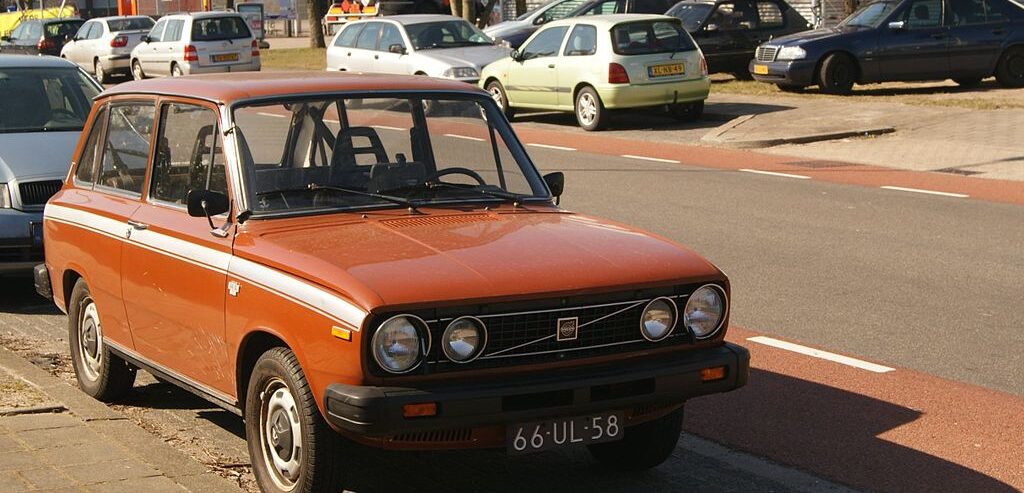
Volvo 66 (1975–1980): The Dutch-Born Classic Explained
Volvo 66 (1975–1980): The Little Volvo with Dutch Roots
The Volvo 66 occupies a genuinely unique place in the history of the Swedish automaker. Produced between 1975 and 1980, this compact saloon and estate was technically and aesthetically rooted in the Dutch DAF 66 — and it marked Volvo’s deliberate entry into the segment of compact city cars. For many European drivers of the late 1970s, the Volvo 66 was their first encounter with a Swedish car, and it left a lasting impression: practical, safe, easy to drive, and surprisingly characterful. Today, it remains one of the most overlooked yet genuinely rewarding classic Volvos to own and collect.
Production History: How Volvo Inherited a Dutch Classic
The story of the Volvo 66 begins not in Gothenburg, but in Eindhoven, the Netherlands. DAF — Van Doorne’s Automobielfabriek — had been producing small, innovative cars since the late 1950s, most famously thanks to their patented Variomatic continuously variable transmission (CVT). The DAF 66, launched in 1972, was a refined evolution of the DAF 55 and was available as a saloon and a practical estate (Marathon). It earned a loyal following across Europe, particularly among drivers who valued its effortless, clutch-free driving experience.
In 1974, Volvo acquired a majority stake in DAF’s passenger car division, taking full control of its production facilities in Born, the Netherlands. Rather than discontinuing the existing models, Volvo made the pragmatic decision to continue production under the Volvo name. The DAF 66 was updated, safety-enhanced, and relaunched as the Volvo 66 in 1975. Production continued until 1980, by which point over 100,000 units had been built across all variants. The Born plant would later go on to produce the highly successful Volvo 340 and 360 series.
If you want to dive deeper into this fascinating chapter of automotive history, there are some excellent reference works available. A great starting point is a Volvo classic car history book — ideal for enthusiasts who want the full picture of how Volvo evolved from Sweden’s safety-focused brand into a pan-European manufacturer.
Design and Styling: Michelotti Meets Volvo
The original DAF 66 was styled by Giovanni Michelotti, one of the most prolific and celebrated Italian automotive designers of the twentieth century. Michelotti’s work gave the DAF 66 clean, crisp lines with a compact yet balanced silhouette — a design that aged well and looked equally at home on city streets and country roads. The estate variant, known as the Marathon, was particularly handsome and practical.
When Volvo took over, they were careful not to erase what worked. Instead, they made targeted visual changes to bring the car into the Volvo family:
- Redesigned front grille with Volvo’s characteristic diagonal iron mark badge
- Reinforced and restyled bumpers to meet improved impact standards
- Enhanced passive safety features, including improved crumple zone design
- Revised interior trim with Volvo-branded steering wheel and instruments
- Updated badging throughout the exterior and interior
The result was a car that felt genuinely Volvo in character — trustworthy, solid, safe — while retaining the elegance and lightness of Michelotti’s original design. The Volvo 66 never tried to look like a shrunken 240; it was always its own thing, and that independence is a large part of its enduring appeal among collectors today.
Engines and Performance: Small, Efficient, and Reliable
The Volvo 66 was powered by a range of small, efficient four-cylinder petrol engines, all sourced originally from Renault — a legacy of the earlier DAF 66. These engines were compact, smooth, and well-suited to the light bodywork of the car. While no one would describe the Volvo 66 as a sports car, it offered perfectly adequate performance for everyday use, and its light weight made the most of the modest power outputs available.
| Engine | Type | Displacement | Power Output | Notes |
|---|---|---|---|---|
| 1.1 L | 4-cylinder OHV | 1,089 cc | 47 hp (35 kW) | Base engine, Renault-derived |
| 1.3 L | 4-cylinder OHV | 1,289 cc | 57 hp (42 kW) | Most common variant |
| 1.4 L | 4-cylinder OHV | 1,397 cc | 63 hp (46 kW) | Later, more powerful option |
Fuel economy was a notable strength of the Volvo 66. At a time when the oil crisis of the mid-1970s had made running costs a serious concern for European car buyers, the 66’s modest engines returned competitive consumption figures. Combined with the Variomatic transmission, which allowed the engine to operate at its most efficient rev range under normal driving conditions, everyday fuel costs were kept admirably low.
The Variomatic Transmission: A Revolutionary Feature
Without question, the most distinctive technical feature of the Volvo 66 — inherited directly from DAF — was the Variomatic continuously variable transmission. Unlike any conventional manual or automatic gearbox of the period, the Variomatic used a pair of rubber drive belts and expanding pulleys to provide an infinitely variable gear ratio between the engine and the rear wheels. There was no clutch pedal, no gear lever to operate, and no interruption in power delivery.
For drivers in urban environments, this was transformative. Stop-start traffic, hill starts, and slow manoeuvring all became effortless. The Variomatic also had one entertaining quirk: because the transmission worked in both directions equally, the Volvo 66 — like all Variomatic-equipped DAFs — could technically reverse at the same speed as it could go forward. This became the stuff of automotive legend and won DAF (and later Volvo) lasting fame on the European racing circuit, where Variomatic-equipped cars competed in their own class with remarkable success.
Body Variants and Specifications
The Volvo 66 was available in two body styles, both of which remain sought after by classic car enthusiasts today:
| Variant | Body Style | Doors | Production Years | Notes |
|---|---|---|---|---|
| Volvo 66 Saloon | 2-door saloon (notchback) | 2 | 1975–1980 | Standard version, most common |
| Volvo 66 Estate (DL) | 3-door estate (kombi) | 3 | 1975–1980 | Known as Marathon; highly practical |
The estate variant was particularly well received in Northern Europe, where its generous load capacity and low loading lip made it a favourite among young families and small business owners. Both variants sat on a wheelbase of 2,250 mm, with an overall length of approximately 3,980 mm — compact by any standard, but cleverly packaged to maximise interior space.
Key Technical Specifications at a Glance
| Specification | Details |
|---|---|
| Manufacturer | Volvo Cars (produced in Born, Netherlands) |
| Production period | 1975 – 1980 |
| Total units produced | Approx. 100,000+ |
| Body styles | 2-door saloon, 3-door estate |
| Engine options | 1.1 L, 1.3 L, 1.4 L four-cylinder petrol |
| Transmission | Variomatic CVT (standard) |
| Drive layout | Front-engine, rear-wheel drive |
| Wheelbase | 2,250 mm |
| Kerb weight | Approx. 780–850 kg |
| Top speed | Approx. 140 km/h (1.4 L) |
| Designer | Giovanni Michelotti (original DAF 66) |
Safety: Volvo’s Contribution to a Small Car
One of the most important things Volvo brought to the DAF 66 platform was its deeply ingrained safety culture. By the mid-1970s, Volvo had already established itself as the global leader in automotive safety, having introduced the three-point seatbelt to the world in 1959. When they took over DAF’s passenger car operations, safety improvements were non-negotiable.
The Volvo 66 received reinforced body structures, energy-absorbing bumpers, and improvements to the passenger cell’s rigidity. Standard fitment of seatbelts across all seating positions was a given. While the 66 was never tested or marketed with the same emphasis on crash safety as the larger Volvo 240 or 260 series, it was nonetheless a significantly safer small car than most of its contemporaries in the late 1970s European market.
The Volvo 66 as a Classic Car Today
In today’s classic car market, the Volvo 66 remains pleasingly undervalued — which is both a frustration for those who know how good it is and an opportunity for those looking to enter classic Volvo ownership at a sensible price point. Surviving examples in good condition are increasingly rare, particularly the estate variant, which suffered from the practical use that made it so popular new. Rust, as with all classic cars of this era, is the primary concern, with the sills, wheel arches, and floor pan being the most critical areas to inspect.
The Variomatic transmission, while unique and characterful, requires specialist knowledge for maintenance and repair. Finding a mechanic with genuine Variomatic experience is essential, and sourcing the rubber drive belts — while not impossible — requires patience and access to specialist suppliers. For those who do invest the time and resources, however, the reward is a truly distinctive driving experience that no modern car can replicate.
For those looking to find, identify, or restore a Volvo 66, a selection of Volvo 66 and DAF 66 spare parts can be found through specialist suppliers — and it is worth checking online marketplaces regularly, as parts availability has improved considerably in recent years thanks to the dedicated community of DAF and Volvo 66 enthusiasts across Europe.
Collectors with a passion for scale models will be pleased to know that both DAF 66 and Volvo 66 diecast models have been produced over the years. A DAF 66 or Volvo 66 diecast model makes a wonderful display piece and a thoughtful gift for any classic car enthusiast.
Why the Volvo 66 Deserves More Recognition
The Volvo 66 has long lived in the shadow of its more famous siblings — the boxy, dependable Volvo 240 and the stylish Volvo P1800. Yet in many ways, the 66 tells a richer and more complex story about Volvo as a company: a story of international expansion, industrial pragmatism, and the willingness to adopt and improve the best ideas of others. It bridges the gap between the DAF era and the modern Volvo, between Dutch engineering ingenuity and Swedish safety philosophy.
For the serious Volvo enthusiast, the 66 is an essential part of understanding the brand’s full history. For the classic car collector looking for something genuinely unusual, practical, and affordable, it is one of the most interesting choices available. And for anyone who simply loves driving, the Variomatic experience alone is worth the price of admission.
Frequently Asked Questions About the Volvo 66
What is the Volvo 66 and when was it produced?
The Volvo 66 is a compact saloon and estate car produced by Volvo between 1975 and 1980 at the former DAF factory in Born, the Netherlands. It was based on the DAF 66 and represented Volvo’s entry into the small car segment following their acquisition of DAF’s passenger car division in 1974.
What is the connection between the Volvo 66 and DAF?
The Volvo 66 is a direct development of the DAF 66. When Volvo acquired DAF’s car manufacturing operations in 1974, they continued production of the DAF 66 under the Volvo name, adding safety enhancements, updated styling, and Volvo badging. The two cars share the same basic platform, engine family, and Variomatic transmission.
What is the Variomatic transmission in the Volvo 66?
The Variomatic is a continuously variable transmission (CVT) developed by DAF. It uses rubber drive belts and expanding pulleys to provide an infinitely variable gear ratio, eliminating the need for a clutch or manual gear changes. It was standard equipment on the Volvo 66 and is one of the car’s most distinctive features.
Who designed the Volvo 66?
The original body design of the DAF 66 — which became the Volvo 66 — was created by Giovanni Michelotti, the renowned Italian automotive designer. Volvo made modifications to the front end, bumpers, and interior trim to align the car with the Volvo brand identity.
Is the Volvo 66 a good classic car to buy?
The Volvo 66 is an excellent classic car for enthusiasts who appreciate unusual history and a unique driving experience. It is currently undervalued relative to more famous classics, making it an accessible entry point. Key considerations are rust in the bodywork and the specialist knowledge required to maintain the Variomatic transmission. Well-preserved examples are increasingly difficult to find.
How many Volvo 66 cars were produced?
Approximately 100,000 units of the Volvo 66 were produced across all variants between 1975 and 1980. This includes both the two-door saloon and the three-door estate (Marathon) body styles.
What engines did the Volvo 66 use?
The Volvo 66 used small, Renault-derived four-cylinder petrol engines in three displacements: a 1.1-litre producing 47 hp, a 1.3-litre producing 57 hp, and a 1.4-litre producing approximately 63 hp. All were OHV units known for reliability and reasonable fuel economy.
Comments
Leave a Comment