
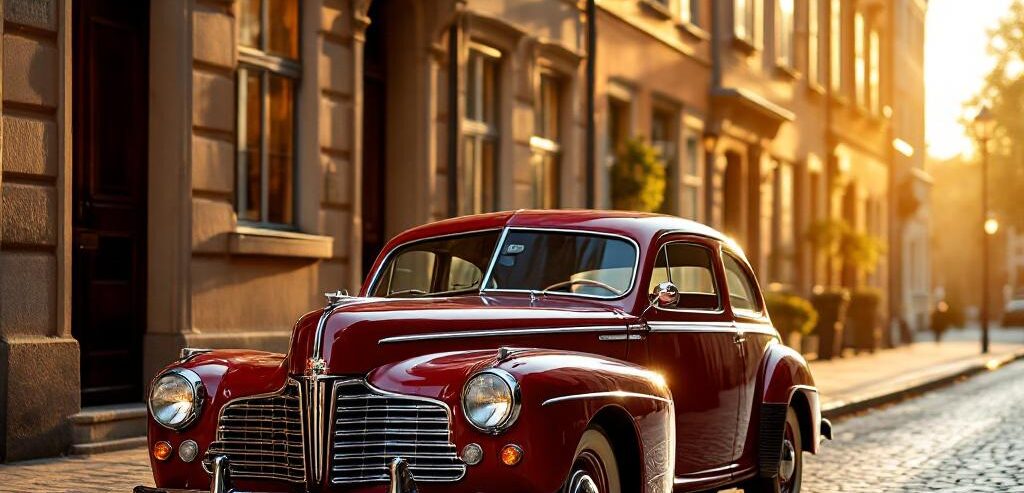
Volvo History: From 1927 to Today | Complete Guide
Volvo Company History: How a Ball Bearing Factory Became a Legend
When I stand in my garage today and start the six-cylinder engine of my Volvo 164, I sometimes think about how it all began. Not with a giant corporation, not with million-dollar investors — but with two Swedish engineers, one powerful idea, and an unshakeable determination to build cars capable of surviving the harsh Scandinavian climate. For me, the history of Volvo is far more than a corporate timeline. It is the story of a philosophy — a deeply rooted belief in quality, safety, and durability — that remains tangible in every classic Volvo I restore or drive today.
In this article, I will take you through nearly a century of Volvo history, from the founding year of 1927, through the golden decades of iconic classic and youngtimer models, all the way to the modern era of electric mobility. Having spent over 20 years immersed in the world of classic Volvos across Europe, I can tell you that understanding the technical and cultural background of this brand is one of the most valuable tools you can have when it comes to restoring, maintaining, or simply appreciating these extraordinary cars.
Whether you are a seasoned Volvo collector or just beginning your journey into Swedish automotive heritage, this complete guide to Volvo company history will give you the context, the facts, and the passion behind one of the world’s most enduring automobile brands.
The Founding: Assar Gabrielsson and Gustaf Larson — Two Visionaries from Gothenburg
The 14th of April, 1927, is the official birthday of Volvo. On that day, the very first Volvo automobile — the ÖV 4, affectionately nicknamed “Jakob” — rolled off the production line in Gothenburg, Sweden. But the real story begins a few years earlier, in the minds of two men who believed the automotive market was failing the Swedish people.
Assar Gabrielsson was the Sales Director at the ball bearing manufacturer SKF, while Gustaf Larson worked as a talented mechanical engineer. Both shared a single conviction: a car built for Swedish conditions must be robust, reliable, and affordable for the ordinary working man. The American vehicles being imported into Europe at the time were simply not designed for icy winters, unpaved country roads, and extreme temperature fluctuations. Sweden needed its own car — built by Swedes, for Swedes.
SKF provided the initial capital to make the dream a reality, and in doing so left the first symbolic imprint on Volvo’s corporate DNA: quality in every bearing, every joint, every single component. The name “Volvo,” incidentally, derives from the Latin verb volvere, meaning “I roll” — a modest yet perfectly fitting description that has remained relevant for nearly a hundred years. If you want to explore the full depth of this founding story, I highly recommend picking up a copy of a dedicated book on Volvo’s history, several of which offer remarkable archival photography and firsthand accounts.
The Early Models: ÖV 4 and PV 651
The ÖV 4 was an open touring car powered by a 1.9-litre four-cylinder engine producing 28 horsepower. It was no technological marvel by any measure, but it worked — reliably and robustly. Even in those first production years, the traits that would come to define Volvo were already clearly visible: conservative engineering, proven solutions, and an obsessive focus on longevity.
By 1929, Volvo had already introduced the PV 651, an enclosed saloon with a six-cylinder engine, signalling the brand’s rapid ambition. Sweden, as a fast-growing industrial nation, had a rising demand for dependable vehicles — both privately and for commercial and government use. Volvo stepped in to meet that need with confidence.
| Model | Year | Engine | Power Output | Significance |
|---|---|---|---|---|
| ÖV 4 “Jakob” | 1927 | 1.9L | 28 hp | First Volvo ever produced |
| PV 651 | 1929 | 3.0L | 55 hp | First enclosed Volvo saloon |
| PV 444 | 1947 | 1.4L | 40 hp | Post-war breakthrough model |
| Amazon(P120) | 1956 | 1.6L–2.0L | Up to 118 hp | Iconic classic, globally loved |
| P1800 | 1961 | 1.8L–2.0L | Up to 124 hp | Sports coupé, symbol of elegance |
| 140 Series | 1966 | 1.8L–2.0L | Up to 124 hp | Safety innovation pioneer |
| 240 Series | 1974 | Various | Up to 140 hp | One of the best-selling Volvos |
The Post-War Era: The PV 444 and the Road to International Success
The Second World War severely disrupted European automotive production, but Volvo used the period wisely. In 1947, the company unveiled the PV 444 — a compact, modern saloon that represented a dramatic stylistic and technical leap forward. With its sleek, American-inspired body and a newly developed overhead-valve engine, the PV 444 was an instant success both in Sweden and, crucially, in the emerging export market.
It was the PV 444 and its successor, the PV 544, that first introduced Volvo to North American consumers — a market that would become extraordinarily important to the brand throughout the 1960s and 1970s. Americans were drawn to Volvo’s reputation for reliability and understated practicality, at a time when Detroit’s offerings felt increasingly overblown and fragile.
From a classic car restoration perspective, the PV series remains one of the most rewarding Volvos to work on. The engineering is straightforward, parts availability is excellent through specialist suppliers, and the community of PV enthusiasts across Europe and North America is wonderfully knowledgeable and generous.
The Golden Age: Amazon, P1800, and the Birth of a Cultural Icon
If there is one decade that truly defined Volvo’s identity as a manufacturer of beautiful, purposeful, and enduring automobiles, it is the 1960s. Two models from this era stand above all others in terms of cultural impact and lasting desirability.
The Volvo Amazon (internally designated P120), introduced in 1956, became the backbone of Volvo’s success throughout the late 1950s and 1960s. Elegant, practical, and almost impossibly durable, the Amazon was the car that put Volvo firmly on the global map. It was also the model in which Volvo introduced the world-changing three-point safety belt in 1959 — an invention developed by Nils Bohlin that Volvo made freely available to the entire automotive industry, reportedly saving over one million lives to date.
The Volvo P1800, launched in 1961, told a completely different story. Sleek, sporty, and undeniably glamorous, the P1800 became internationally famous when it appeared alongside Roger Moore in the TV series The Saint. With its curvaceous bodywork and twin SU carburettors, it demonstrated that Volvo was capable of genuine automotive passion alongside its reputation for sensible reliability. One P1800 — owned by American Irv Gordon — famously accumulated over 3 million miles, cementing the model’s legendary status forever.
For anyone wishing to explore this golden era in greater depth, I strongly recommend specialist books covering the Volvo Amazon and P1800, which contain invaluable technical details and stunning period photography.
Safety First: How Volvo Revolutionised Automotive Engineering
No history of Volvo would be complete without a dedicated discussion of safety — the single defining value that has guided the company’s engineering philosophy throughout its entire existence. Volvo’s safety innovations are not marketing slogans; they are genuine, life-saving engineering achievements that have influenced the entire global automotive industry.
Here is a summary of Volvo’s most significant safety milestones:
- 1944: Volvo introduces laminated safety glass as standard equipment
- 1959: Nils Bohlin develops the three-point safety belt — Volvo makes the patent freely available to all manufacturers
- 1966: Introduction of the 140 Series with a crumple zone body structure and reinforced passenger cell
- 1970: Rear-facing child seats introduced as an option
- 1972: Volvo Experimental Safety Car (VESC) concept showcases future passive safety technology
- 1978: First manufacturer to offer a rear-facing child seat integrated into the front passenger seat
- 1991: Side impact protection system (SIPS) introduced
- 1998: Whiplash Protection System (WHIPS) developed for rear-end collisions
- 2008: City Safety automatic emergency braking introduced on the XC60
- 2020: Volvo announces a maximum speed limit of 180 km/h on all new vehicles as a corporate safety statement
When I am restoring a classic Volvo 140 or 240 and I peel back the layers of paint and filler to find those still-solid structural pillars, I am reminded of something important: these cars were engineered to protect people. That was not an accident. It was a deliberate, courageous corporate decision made at a time when most manufacturers were focused purely on performance and aesthetics.
The 240 and 740 Series: Volvo’s Most Beloved Classic Workhorses
For many European Volvo enthusiasts of my generation, the words “Volvo” and “indestructible” are practically synonymous — and that reputation was built almost entirely on the shoulders of the 240 and 740 series.
The Volvo 240, produced from 1974 to 1993, became one of the longest-running and best-selling model series in automotive history. Its boxy, utilitarian shape may not have set pulses racing on the motorway, but its engineering integrity was extraordinary. Diesel engines regularly ran past 500,000 kilometres with basic maintenance. The rear-wheel-drive platform, derived from the legendary 140 Series, gave it handling characteristics that classic car drivers still appreciate today.
The Volvo 740 and 760, launched in 1982 and 1981 respectively, brought Volvo into a more premium segment while retaining the brand’s core values. The 760 in particular, with its available turbocharged six-cylinder engine and leather interior, represented Volvo’s most ambitious attempt to compete directly with Mercedes-Benz and BMW in the executive car market. From a restoration perspective, the 700 series is currently one of the most exciting areas of the classic Volvo world, with values rising steadily as appreciation for these cars grows.
The Ford Era and the Road to Independence
In 1999, Ford Motor Company acquired Volvo’s passenger car division for approximately 6.45 billion US dollars — a transaction that caused considerable anxiety among loyal Volvo enthusiasts worldwide, including myself. Would the Swedish identity survive? Would cost-cutting compromise the engineering standards that had made Volvo great?
The reality was nuanced. Under Ford ownership, Volvo benefited from significant investment in new platforms and technology, resulting in acclaimed models such as the XC90, the V70, and the award-winning S40. However, the global financial crisis of 2008 forced Ford to reassess its portfolio, and in 2010, Volvo Cars was sold to the Chinese automotive group Geely for 1.8 billion US dollars.
The Geely acquisition, initially viewed with scepticism, has proven to be one of the more successful automotive ownership transitions of the modern era. Under Geely, Volvo has invested heavily in electrification, Scandinavian design, and premium positioning — while maintaining its Swedish engineering headquarters in Gothenburg.
Volvo Today: Electrification, Design, and a New Chapter
Today, Volvo Cars is one of the most forward-thinking premium automotive brands in the world. The company has committed to becoming fully electric by 2030 and has invested billions in developing a new generation of battery-electric vehicles built on its dedicated EX and EC platforms. Models such as the EX90, EX40, and EC40 have received widespread critical acclaim for their combination of Scandinavian design sensibility, advanced safety technology, and genuine driving refinement.
It is, admittedly, a long way from the ÖV 4 “Jakob” of 1927. But if Assar Gabrielsson and Gustaf Larson could see what their company has become, I believe they would recognise something familiar in those modern Volvos: the same uncompromising commitment to building vehicles that genuinely serve the people who drive them.
For those who want the complete picture — from Gothenburg in 1927 to the electric future — I recommend exploring a comprehensive book covering the complete Volvo car history, which makes an excellent reference for enthusiasts and restorers alike.
Key Milestones in Volvo History: A Complete Timeline
| Year | Milestone |
|---|---|
| 1927 | Volvo founded; first car ÖV 4 “Jakob” produced in Gothenburg |
| 1929 | First six-cylinder model PV 651 introduced |
| 1947 | PV 444 launched; Volvo enters the export market |
| 1956 | Volvo Amazon (P120) introduced |
| 1959 | Three-point safety belt introduced and patent made freely available |
| 1961 | Volvo P1800 sports coupé launched |
| 1966 | 140 Series introduced with crumple zone technology |
| 1974 | 240 Series launched — produced until 1993 |
| 1982 | 740/760 Series introduced |
| 1991 | 850 Series — Volvo’s first front-wheel-drive car |
| 1999 | Ford Motor Company acquires Volvo Cars |
| 2002 | First-generation XC90 launched to global acclaim |
| 2010 | Geely acquires Volvo Cars |
| 2017 | Volvo announces all new models will be electrified from 2019 |
| 2022 | EX90 fully electric flagship SUV revealed |
| 2030 | Target year for Volvo to become a fully electric car brand |
Why Volvo’s History Matters to Classic Car Enthusiasts
Understanding where Volvo came from is not merely an academic exercise. For those of us who restore, collect, and drive classic Volvos, this history is directly practical. Knowing that the 240’s live rear axle was a deliberate engineering choice for durability rather than a budget compromise helps you appreciate the car differently when you are underneath it. Understanding that the Amazon’s body panels were overengineered for corrosion resistance explains why so many survive today. Recognising that Volvo’s safety philosophy was genuine and deeply held helps you understand why these cars continue to feel so solid, so purposeful, and so rewarding to drive.
The Volvo story is, at its heart, a story about integrity — about a company that consistently chose to do the right thing, even when cheaper or flashier alternatives were available. That is an increasingly rare quality in the modern automotive world, and it is precisely why so many of us remain devoted to these remarkable Swedish cars.
Frequently Asked Questions About Volvo History
When was Volvo founded and by whom?
Volvo was officially founded on the 14th of April, 1927, by Assar Gabrielsson and Gustaf Larson in Gothenburg, Sweden. The company was financially backed by the Swedish ball bearing manufacturer SKF. The first Volvo car, the ÖV 4, was produced on the same day.
What does the name “Volvo” mean?
The name “Volvo” derives from the Latin verb volvere, which means “I roll.” It was originally used as a brand name by SKF for a line of ball bearings before Gabrielsson and Larson adopted it for their new automobile venture.
Who invented the three-point safety belt and when?
The three-point safety belt was invented by Nils Bohlin, a Volvo engineer, and introduced in 1959 on the Volvo Amazon PV 544. In a landmark decision, Volvo made the patent freely available to the entire automotive industry, a move that is widely credited with saving well over one million lives globally.
Who owns Volvo Cars today?
Volvo Cars is currently majority-owned by the Chinese automotive group Geely Holding, which acquired the company from Ford Motor Company in 2010. Despite this ownership structure, Volvo Cars remains headquartered in Gothenburg, Sweden, and retains its Swedish engineering and design identity.
What is the most iconic classic Volvo model?
This depends on who you ask, but the most universally recognised classic Volvo models are the Volvo Amazon (P120), the Volvo P1800, and the Volvo 240 Series. The P1800 is arguably the most visually iconic, made famous by its appearance in the TV series The Saint, while the 240 is widely considered the ultimate expression of Volvo’s core engineering philosophy.
Is Volvo going fully electric?
Yes. Volvo Cars has officially committed to becoming a fully electric vehicle manufacturer by 2030, phasing out all internal combustion engine models. The company is investing heavily in its EX and EC platform of battery-electric vehicles and has already launched several well-received electric models including the EX40, EC40, and the flagship EX90.
What are the best books about Volvo history for enthusiasts?
There are several excellent publications covering Volvo’s history in detail, ranging from broad corporate histories to model-specific restoration guides. For a comprehensive overview, searching for Volvo history books on Amazon will reveal a strong selection of titles suitable for both newcomers to the brand and long-term enthusiasts.
Comments
Leave a Comment