
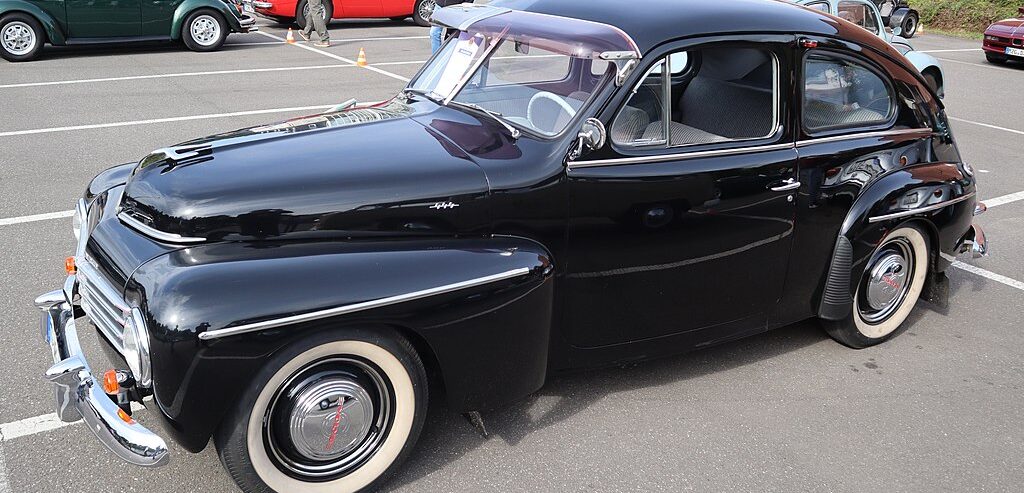
Volvo PV444: History, Specs & Legacy (1946–1958)
The Volvo PV444 stands as one of the most important milestones in automotive history – not just for Volvo as a company, but for Swedish engineering as a whole. Robust, compact, and remarkably reliable, the PV444 became a defining symbol of Scandinavian quality and post-war optimism. With over two decades of experience studying and driving classic Volvos across Europe, I can say with confidence: few cars tell a story as compelling as this one.
When Was the Volvo PV444 Built?
The Volvo PV444 was produced from 1946 to 1958, making it a product of the immediate post-war era. Its public debut, however, came even earlier – in 1944, when Volvo presented the concept to an astonished Swedish audience hungry for a glimpse of peacetime mobility. Due to severe material shortages caused by World War II, full-scale serial production could not begin until after the conflict ended.
This delay only seemed to fuel public excitement. By the time the first production models rolled off the line in Gothenburg, demand had already far exceeded all initial projections. The PV444 was a car the people of Sweden – and eventually the world – had been waiting for.
The History of the Volvo PV444
During the darkest years of World War II, Volvo’s leadership made a bold and forward-thinking decision: rather than waiting passively for peace to return, they would begin engineering the vehicle that would define the post-war decade. The brief was clear – a smaller, more affordable, and more fuel-efficient car than anything Volvo had previously built, designed to meet the needs of ordinary Swedish families.
Drawing inspiration from the sleek American fastback designs of the early 1940s, the PV444 emerged as a car that blended transatlantic styling influences with distinctly Swedish practicality. Its unibody construction – a revolutionary choice for Volvo at the time – gave the vehicle structural integrity and a lower centre of gravity, improving both handling and safety.
Originally, Volvo planned to manufacture a modest run of just 8,000 units. What followed was nothing short of extraordinary. Public enthusiasm was so overwhelming that production ultimately reached over 200,000 vehicles, cementing the PV444 as a genuine mass-market success and laying the foundation for Volvo’s global reputation as a manufacturer of safe, durable, and trustworthy automobiles.
If you’re passionate about the history behind this iconic model, I highly recommend exploring books dedicated to the Volvo PV444 and its era – they offer incredible detail on the engineering decisions and cultural context that shaped this car.
The PV444 also played a pivotal role in Volvo’s early export ambitions. When it made its appearance in the United States market during the late 1950s, it introduced American drivers to the concept of a well-built, safety-conscious European compact – years before that idea became mainstream.
Who Designed the Volvo PV444?
The visual identity of the PV444 was shaped primarily by Helmer MasOlle, Volvo’s chief designer at the time, whose work reflected a deep appreciation for the flowing, aerodynamic forms that American automakers had pioneered in the early 1940s. The 1941 Chrysler Windsor is frequently cited as a key source of aesthetic inspiration, particularly its distinctive fastback roofline and integrated fender treatment.
However, the PV444 was never simply a derivative of American design. MasOlle, working in close collaboration with Volvo CEO Assar Gabrielsson and chief engineer Gustaf Larson – the two co-founders of Volvo – ensured that every styling decision served a functional purpose. The result was a car that looked modern and dynamic while remaining entirely practical for the Scandinavian climate and road conditions.
Gabrielsson and Larson’s guiding philosophy – that “cars are driven by people; therefore safety is and must be our guiding principle” – permeated every aspect of the PV444’s development, from its sturdy welded body to its laminated windscreen glass.
Engines and Performance
The Volvo PV444 was powered by a series of four-cylinder inline petrol engines, all derived from Volvo’s B4B engine family. Over the course of its production run, the engine was progressively refined and upgraded to improve both power output and reliability.
| Engine Code | Displacement | Power Output | Production Period |
|---|---|---|---|
| B4B | 1.4 litres | 40 hp (29 kW) | 1947–1953 |
| B14A | 1.4 litres | 44 hp (32 kW) | 1953–1955 |
| B16A | 1.6 litres | 60 hp (44 kW) | 1957–1958 |
The later introduction of the larger B16A engine, displacing 1.6 litres and producing 60 horsepower, gave the PV444 a noticeably sportier character during its final production years. Paired with a twin-carburettor setup in some variants, this version transformed the modest family car into a surprisingly spirited driver’s machine – a preview of the performance credentials that Volvo would go on to develop further in the PV544 and the Amazon series.
Technical Specifications at a Glance
| Specification | Details |
|---|---|
| Production Years | 1946–1958 |
| Body Style | 2-door fastback saloon |
| Construction | Unibody (monocoque) |
| Engine Options | B4B, B14A, B16A (inline-4) |
| Displacement | 1.4 litre / 1.6 litre |
| Power Range | 40–70 hp depending on variant |
| Transmission | 3-speed manual |
| Wheelbase | 2,600 mm (102.4 in) |
| Length | 4,330 mm (170.5 in) |
| Kerb Weight | approx. 900–950 kg |
| Seating Capacity | 4 passengers |
| Total Units Produced | approx. 200,000+ |
Safety Innovations That Were Ahead of Their Time
Long before safety became a mainstream marketing concept in the automotive industry, Volvo was building it into the DNA of every vehicle they produced. The PV444 was no exception. Its laminated safety glass windscreen, reinforced passenger cell, and hydraulic brakes on all four wheels were genuinely progressive features for a car in this class during the late 1940s and early 1950s.
The unibody construction itself contributed significantly to occupant protection. Unlike body-on-frame vehicles common at the time, the welded monocoque structure distributed crash forces more evenly, reducing the risk of catastrophic cabin intrusion. These principles would later evolve directly into the safety engineering philosophies behind the Volvo Amazon and the landmark Volvo 140 series.
The PV444 in Motorsport
The Volvo PV444 was not merely a reliable family car – it demonstrated a surprising appetite for competition. In the 1950s, tuned versions of the PV444 participated in rally events and circuit races across Scandinavia and Europe. The lightweight body, combined with the increasingly potent B-series engines, made it a formidable contender in its class.
These motorsport activities were instrumental in developing Volvo’s engineering capabilities and reinforcing the brand’s credibility. The lessons learned on Swedish forest roads and European race circuits fed directly back into the production cars, improving reliability and performance for everyday drivers.
For collectors and enthusiasts who want to celebrate this legacy on their desk or shelf, there are some excellent Volvo PV444 diecast model cars available that faithfully reproduce the details of this legendary classic.
The PV444’s Legacy and Successor
When the Volvo PV444 finally gave way to the Volvo PV544 in 1958 – an evolved version sharing the same basic platform but featuring a wider windscreen and numerous mechanical improvements – it left behind a legacy that continues to resonate in the classic car community today.
The PV444 demonstrated that Volvo could compete internationally, not just within Scandinavia. It showed that a car could be both appealing and safe, both affordable and well-engineered. In many ways, it established the brand values that Volvo still holds today: safety, durability, and understated Scandinavian elegance.
Surviving examples of the PV444 are now prized collector’s items, particularly those in original or professionally restored condition. Values have risen steadily over the past decade as the classic Volvo community has grown, and concours-quality examples command serious attention at European vintage car events.
Frequently Asked Questions About the Volvo PV444
What does PV444 stand for?
The designation PV stands for Personvagn, the Swedish word for passenger car. The number 444 refers to the vehicle’s key configuration: a four-cylinder engine, four-stroke operation, and four seats. It was a practical, descriptive naming convention typical of Volvo during that era.
How many Volvo PV444 cars were produced?
Over 200,000 units of the Volvo PV444 were produced between 1946 and 1958. This far exceeded Volvo’s original production target of just 8,000 vehicles, reflecting the extraordinary public demand for the car both in Sweden and internationally.
What engine did the Volvo PV444 use?
The PV444 used a series of four-cylinder inline petrol engines from Volvo’s B-series family. Early models featured the 1.4-litre B4B producing 40 hp, while later versions received the improved B14A and ultimately the more powerful 1.6-litre B16A engine, which produced up to 60 hp in standard form.
Is the Volvo PV444 safe by modern standards?
By contemporary safety standards, the PV444 naturally lacks the passive and active safety systems found in modern vehicles. However, for its era, it was genuinely advanced: featuring laminated windscreen glass, hydraulic four-wheel brakes, and a welded unibody structure that offered better occupant protection than many competitors of the time.
What is the difference between the Volvo PV444 and PV544?
The Volvo PV544, introduced in 1958, was essentially a further development of the PV444 platform. Key differences included a wider, one-piece curved windscreen replacing the PV444’s split screen, a revised interior with increased seating capacity, and improved engine options. The PV544 also received a more modern front fascia treatment.
What is a Volvo PV444 worth today?
The value of a Volvo PV444 varies considerably depending on condition, originality, and provenance. Well-preserved or professionally restored examples in Western Europe typically range from €10,000 to €30,000 or more, with exceptional concours-quality cars occasionally exceeding that range at specialist auctions. Project cars can be found for considerably less.
Where can I find more information or memorabilia about the Volvo PV444?
Beyond dedicated Volvo classic car clubs and owner registers across Europe, there is a rich selection of books and reference guides covering the Volvo PV444 and related classic Volvo models that are invaluable for restorers, historians, and enthusiasts alike.
Comments
Leave a Comment