
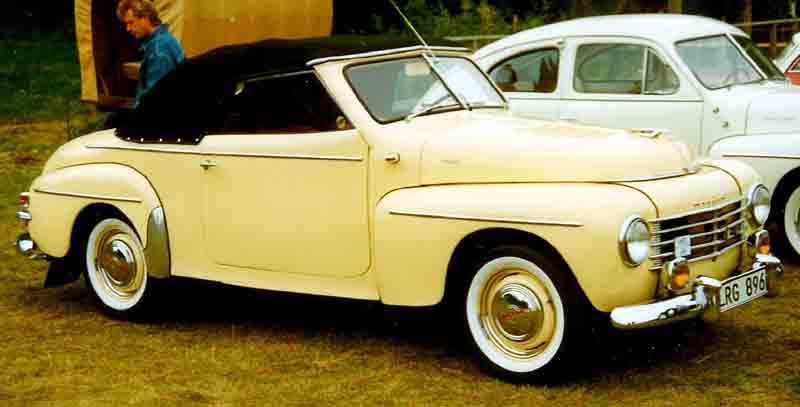
Volvo PV445 & Duett – The Swedish Classic Explained
Volvo PV445 / Duett – The Swedish Classic That Defined Practical Motoring
The Volvo PV445, widely known as the Volvo Duett, was far more than just a station wagon. It was the first Volvo specifically conceived as a versatile workhorse and family car in one – and it remains one of the most iconic and beloved models ever to carry the Swedish brand’s iron mark. For collectors and enthusiasts across Europe and beyond, the Duett represents a golden era of honest, purposeful engineering combined with unmistakable Scandinavian character.
As someone who has spent over two decades studying, driving, and restoring classic Volvos, I can say with confidence that the PV445 and its Duett derivatives occupy a very special place in automotive history – one that is often underestimated outside dedicated enthusiast circles. This article aims to change that.
When Was the Volvo PV445 Built?
The Volvo PV445 was produced between 1949 and 1960. However, the story does not end there. The estate and panel van derivative, officially named the Volvo Duett, continued in production in the form of the Volvo P210 all the way until 1969 – making it one of the longest-running Volvo models of the postwar era.
This remarkable 20-year production span speaks volumes about the fundamental soundness of the design. While the automotive world changed dramatically around it, the Duett soldiered on, serving tradespeople, rural families, doctors, and small business owners across Scandinavia and increasingly across the rest of Europe.
The History of the Volvo PV445 and Duett
Following the commercial and critical success of the Volvo PV444 – a compact, modern saloon that had surprised the market in 1947 – Volvo’s management quickly recognised a growing demand for a more utilitarian derivative. Sweden in the late 1940s was a country of farmers, craftsmen, and small entrepreneurs who needed a vehicle that could carry passengers on weekdays and deliver goods or equipment without compromise.
The solution was elegantly simple: extend the proven PV444 chassis and offer it as a platform for coachbuilders, delivery van constructors, and specialist vehicle builders. In its earliest form, the PV445 was sold as a cab-over chassis – essentially a rolling platform with a cab, waiting for external coachbuilders to add whatever body the customer required. This made the vehicle extraordinarily flexible, and a wide variety of body styles appeared in the early 1950s, from ambulances and hearses to milk floats and forestry vehicles.
The turning point came in 1953, when Volvo itself began producing a factory-built estate version of the PV445. This model was officially christened the Duett – a name deliberately chosen to reflect its dual nature as both a private family car and a professional working vehicle. The name was perfectly chosen: the Duett truly performed two roles without making significant compromises in either direction.
If you want to dive deeper into this fascinating era of Swedish automotive history, there are some excellent resources available. A well-researched Volvo classic car history book can provide detailed documentation, original photographs, and engineering specifications that bring this era to life.
Who Designed the Volvo PV445 and Duett?
The foundational design of the PV445 can be traced directly back to Helmer Petterson, Volvo’s chief designer and the creative force behind the PV444. Petterson had spent time in the United States studying American design trends and brought back a sensibility for clean, rounded lines combined with structural integrity – qualities clearly visible in the PV444’s body and carried over into the PV445.
The Duett estate body was developed internally at Volvo, heavily influenced by practical considerations rather than stylistic ambition. This was never intended to be a show car or a design statement. It was a tool – a well-made, thoughtfully proportioned, thoroughly Swedish tool. And yet, with the benefit of hindsight and the patina of decades, the Duett has become genuinely charming to look at. Its split rear door, large glass area, and upright, honest proportions give it a personality that modern crossovers simply cannot replicate.
The Duett’s design philosophy aligns closely with what we now call Scandinavian functionalism – the idea that honest, purpose-driven design is intrinsically beautiful. In that respect, the Duett was decades ahead of its time.
Volvo PV445 and Duett Engine Specifications
Over its long production life, the PV445 and Duett were fitted with several generations of Volvo’s own four-cylinder engines. Each update brought improved reliability, power, and refinement – though always within the context of practical, everyday Swedish motoring rather than performance for its own sake.
| Engine Code | Displacement | Power Output | Years Used | Notes |
|---|---|---|---|---|
| B4B | 1.4 litre | 40–44 hp | 1949–1955 | Side-valve unit, robust and simple |
| B14A | 1.4 litre | ~50 hp | Early 1950s (selected variants) | Improved carburation over B4B |
| B16A | 1.6 litre | ~60 hp | Mid to late 1950s | OHV unit, significant improvement |
| B16B | 1.6 litre | ~70 hp | Late 1950s–1960s | Twin carburettors, sportier tune |
While these power figures may appear modest by contemporary standards, they must be understood in context. The Duett was never a sports car. It was designed to carry loads reliably over long distances on unpaved Swedish roads in temperatures that regularly dropped well below freezing. In that environment, mechanical simplicity, torque at low revs, and bulletproof reliability were worth far more than horsepower. The Volvo four-cylinders of this era developed a legendary reputation for durability – a reputation the brand still draws upon today.
Body Variants and Configurations
One of the most interesting aspects of the PV445 platform is the sheer variety of body configurations it supported. Because the vehicle was initially offered as a bare chassis, a remarkable range of specialist bodies were built upon it during the 1950s. Even after Volvo introduced the factory Duett body, independent coachbuilders continued to offer alternatives.
- Estate / Station Wagon (Duett): The most familiar variant, with a split tailgate, folding rear seats, and a large cargo area. Equally at home transporting a family or a load of tools.
- Panel Van: A closed cargo body with no rear side windows, popular with tradespeople and delivery companies across Scandinavia.
- Pick-up Truck: An open load bed configuration, used extensively in rural and agricultural settings.
- Ambulance: Several Scandinavian municipalities operated PV445-based ambulances during the 1950s and early 1960s.
- Hearse: Funeral coachbuilders in Sweden and the Netherlands created elongated hearse versions on the PV445 chassis.
- Specialist Vehicles: Forestry vehicles, refrigerated delivery vans, and even mobile workshops were built on the PV445 platform by specialist coachbuilders.
This versatility makes the PV445 a genuinely unique vehicle in Volvo’s history – no other model before or since has served such a wide range of purposes while sharing essentially the same mechanical foundation.
The Volvo P210: The Duett’s Final Evolution
By the late 1950s, the PV444-derived saloon had been replaced by the more modern Volvo Amazon (P120). Rather than retiring the Duett, Volvo updated it cosmetically and mechanically, and it continued in production under the designation P210 until 1969. The P210 received a more modern front fascia, updated engines, and various refinements, but retained the fundamentally honest character of the original Duett concept.
The P210 is often considered the most practical and usable of all the Duett variants for modern classic car enthusiasts, as it benefits from the most developed mechanical specification while still retaining all the period charm that makes these vehicles so appealing. Finding good examples today requires patience, but the rewards are considerable.
For collectors who appreciate scale models of these rare vehicles, a Volvo Duett diecast model makes a wonderful addition to any classic car display – and a surprisingly hard-to-find collector’s item in its own right.
Why the Volvo Duett Is a Sought-After Classic Today
The Volvo Duett’s collector appeal rests on several well-founded pillars. First and foremost is rarity: relatively few examples survive in good condition, particularly outside Scandinavia, because so many were worked hard throughout their lives and eventually scrapped rather than preserved. Finding an original, unrestored Duett with solid bodywork is a genuine discovery.
Second is the vehicle’s outstanding mechanical accessibility. The four-cylinder engines used in the PV445 and Duett series are robust, well-documented, and relatively straightforward to work on even today. Parts availability has improved significantly over the past decade, with specialists across Sweden, the Netherlands, and Germany stocking reproduction and new-old-stock components.
Third – and perhaps most importantly for many enthusiasts – is the Duett’s sheer character. These are vehicles that reward engagement. They demand a certain commitment from the driver: double-declutching, careful management of the modest power output, and an appreciation for the genuine physical connection between car and road that was normal in the 1950s but has largely disappeared from modern motoring.
Owning and driving a Volvo Duett is, in many ways, a philosophical statement about what motoring can and should be. It is a vehicle that encourages presence, patience, and appreciation – qualities that are, if anything, more valuable today than they were when the car was new.
Volvo PV445 / Duett – Key Facts at a Glance
| Specification | Details |
|---|---|
| Production Years | 1949–1960 (PV445); 1953–1969 (Duett / P210) |
| Body Styles | Estate, panel van, pick-up, specialist coachbuilt bodies |
| Designer | Helmer Petterson (base); Volvo internal design team (Duett body) |
| Engines | B4B (1.4 l), B14A (1.4 l), B16A / B16B (1.6 l) |
| Power Range | 40–70 hp depending on engine variant |
| Platform Basis | Extended Volvo PV444 chassis |
| Final Evolution | Volvo P210 (1960–1969) |
| Country of Origin | Sweden (Gothenburg) |
Frequently Asked Questions About the Volvo PV445 and Duett
What is the difference between the Volvo PV445 and the Volvo Duett?
The Volvo PV445 is the chassis designation for the entire family of utility vehicles built between 1949 and 1960. The Volvo Duett is specifically the estate (station wagon) and panel van body variant introduced by Volvo in 1953. All Duetts are PV445 derivatives, but not all PV445 vehicles are Duetts – many were delivered as bare chassis to external coachbuilders.
How long was the Volvo Duett in production?
The Volvo Duett, including its later incarnation as the Volvo P210, remained in production for an impressive 16 years, from 1953 to 1969. The underlying PV445 chassis was produced from 1949, making the overall platform lifespan even longer at approximately 20 years.
What does the name “Duett” mean?
The name Duett (Swedish for “duet”) was chosen to reflect the vehicle’s dual purpose: it was designed to serve equally well as a private family car and as a professional working vehicle. This dual identity was a genuine engineering and marketing achievement for Volvo at the time.
Is the Volvo PV445 Duett a good classic car to own?
For enthusiasts with mechanical aptitude and a genuine appreciation for vintage motoring, the Volvo Duett is an excellent classic car choice. It is mechanically robust, relatively simple to maintain, increasingly well-supported by specialist parts suppliers, and absolutely distinctive in any classic car gathering. It is not a fast or flashy car, but it is deeply characterful and rewarding to own and drive.
How many Volvo Duetts were produced?
Exact total production figures vary across sources, but it is estimated that approximately 100,000 units of the PV445 and its Duett/P210 derivatives were produced across the full production run. Given that many were used as genuine working vehicles, surviving examples in good condition are now relatively rare.
Where can I find parts for a Volvo PV445 or Duett?
Parts availability for the Volvo Duett has improved considerably in recent years. Specialist suppliers in Sweden, the Netherlands, Germany, and the United Kingdom stock a wide range of mechanical and body components. Swedish clubs such as the Volvo PV Club and international Volvo classic car registries are also invaluable resources for connecting with suppliers, restorers, and fellow owners.
What is the Volvo P210?
The Volvo P210 is the final evolution of the Duett concept, produced from 1960 to 1969. It features a modernised front end design, updated mechanical components including the more refined B16 engine family, and various detail improvements over the original PV445-based Duett. It is visually distinct from its predecessors and is often considered the most practical and usable version for modern classic car use.
Whether you are a seasoned Volvo collector or simply curious about the history of Swedish motoring, the PV445 and Duett richly reward further study. A dedicated Volvo PV series reference book is one of the best investments any enthusiast can make – these vehicles have a history that is genuinely worth knowing in depth.
Comments
Leave a Comment