
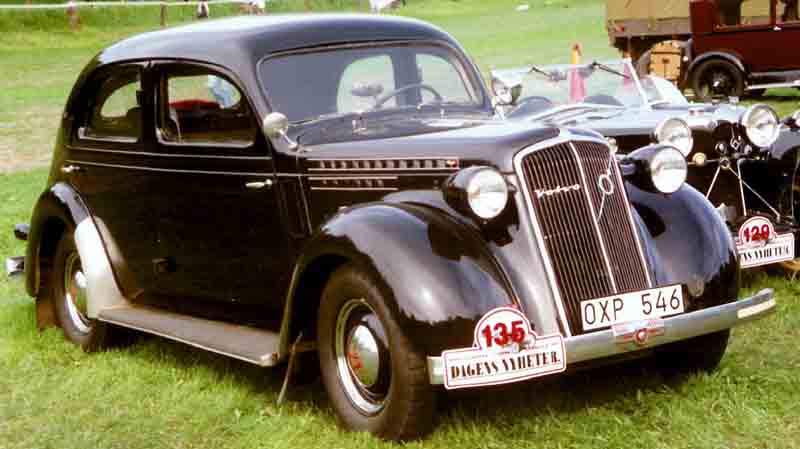
Volvo PV51: The Swedish Mid-Range Car of the 1930s
The Volvo PV51 represents one of the most significant milestones in Volvo’s early history — a dependable, affordable mid-range saloon that brought Swedish automotive engineering within reach of a much broader audience. Produced from 1936 to 1938, the PV51 was more than just a budget alternative to its glamorous predecessor, the PV36 “Carioca.” It was a carefully engineered vehicle that balanced classical design, proven mechanics, and practical value during one of the most challenging economic periods of the 20th century. For anyone passionate about vintage Scandinavian automobiles, the Volvo PV51 is an essential chapter in the story of how a small Swedish manufacturer grew into a global automotive icon.
When Was the Volvo PV51 Built?
The Volvo PV51 was produced between 1936 and 1938, making it a direct product of the mid-Depression recovery era. However, its legacy extended well beyond those two years. The PV51 served as the technical and stylistic foundation for a series of closely related models — including the PV52, PV53, PV54, and PV56 — that continued in various forms until 1945. Together, this family of vehicles bridged the gap between Volvo’s pre-war craftsmanship and the more modern designs that would emerge after World War II. In total, fewer than 1,000 PV51 units were manufactured during its short production run, making surviving examples rare and highly sought after by collectors today.
The History of the Volvo PV51
To fully appreciate the Volvo PV51, you need to understand the economic climate in which it was born. The early 1930s had been devastating for the global economy, and even Sweden — relatively sheltered from the worst effects of the Great Depression — saw consumer purchasing power severely curtailed. Volvo had previously introduced the PV36 “Carioca” in 1935, a strikingly modern, streamlined saloon inspired by the Chrysler Airflow. While the PV36 was an impressive achievement in automotive design and aerodynamics, it was also expensive and therefore out of reach for most Swedish families.
Volvo’s management recognised the need for a more accessible vehicle — something that retained the brand’s reputation for solidity and reliability but at a price that ordinary middle-class buyers could afford. The result was the Volvo PV51, launched in 1936. Rather than chasing aerodynamic modernity, the PV51 embraced a more conservative, upright design with a traditional straight front grille, freestanding front mudguards, and a sturdy, box-like body structure. The interior was functional rather than luxurious, with durable materials chosen for longevity over elegance.
Despite — or perhaps because of — its no-frills approach, the PV51 found a loyal customer base across Scandinavia. Swedish doctors, small business owners, and rural families appreciated its ruggedness on unpaved roads and its straightforward mechanical layout, which made maintenance and repairs relatively simple even outside major cities. If you are looking to explore this era of Swedish automotive history in greater depth, a well-researched book on classic Volvo history makes an excellent companion to any collector’s library.
Who Designed the Volvo PV51?
The design of the Volvo PV51 was developed entirely in-house at Volvo’s Gothenburg headquarters. The project was overseen by Gustaf Larson, one of Volvo’s co-founders and the company’s technical visionary, alongside chief designer Helmer MasOlle, who had previously contributed to the styling of the PV36. While MasOlle had embraced the flowing, streamlined aesthetics for the Carioca, the PV51 demanded a different approach — one that prioritised structural simplicity, cost efficiency, and broad market appeal over stylistic ambition.
The resulting design drew on established pre-war conventions: a tall, upright radiator grille, separate front wings with integrated headlamps, a flat windscreen, and a three-box body profile. Although it lacked the visual drama of the PV36, the PV51 possessed a dignified, purposeful character that was entirely appropriate for its role as a working family car. Today, that honest, unadorned aesthetic is precisely what makes surviving PV51 examples so charming to vintage car enthusiasts.
Volvo PV51 Engine and Technical Specifications
The Volvo PV51 was powered by a naturally aspirated inline four-cylinder engine, designated the Type EC. This was a well-proven unit that Volvo had developed and refined through the early 1930s, chosen for the PV51 specifically because of its reliability and ease of maintenance. Below is a comprehensive overview of the vehicle’s technical specifications:
| Specification | Details |
|---|---|
| Production Years | 1936 – 1938 |
| Body Style | 4-door saloon (sedan) |
| Engine Type | Inline 4-cylinder, Type EC |
| Engine Displacement | 3,670 cc |
| Maximum Power Output | approx. 86 hp (in later variants) |
| Fuel System | Downdraught carburettor |
| Gearbox | 3-speed manual transmission |
| Suspension (front) | Transverse leaf spring |
| Suspension (rear) | Live rear axle with longitudinal leaf springs |
| Brakes | Hydraulic drum brakes (all four wheels) |
| Wheelbase | 2,870 mm |
| Units Produced | approx. 998 |
The 3,670 cc displacement was notably generous for a mid-range car of its era, contributing to the PV51’s reputation for unhurried, effortless performance on Swedish roads. The downdraught carburettor ensured reliable fuel delivery even in cold Nordic winters — an absolutely essential characteristic for any vehicle intended for year-round Scandinavian use.
The PV51 Model Family: Variants and Successors
One of the most important aspects of the Volvo PV51’s legacy is the model family it spawned. Rather than treating the PV51 as a standalone vehicle, Volvo used it as an evolving platform throughout the late 1930s and into the war years. The following variants were derived from or closely related to the original PV51:
- Volvo PV51 (1936–1938): The original four-door saloon, the foundation of the entire series.
- Volvo PV52 (1937–1938): A more upmarket variant featuring a longer wheelbase and improved interior trim, aimed at buyers who wanted additional comfort without paying for the full luxury of the PV36.
- Volvo PV53 (1938–1940): An updated version with minor styling revisions, reflecting the gradual transition towards slightly more modern aesthetics in pre-war European car design.
- Volvo PV54 (1940–1941): Introduced wartime-era modifications, including simplified trim and reduced chrome detailing due to material shortages.
- Volvo PV56 (1942–1945): The final development of the series, featuring further wartime economies while maintaining the essential mechanical architecture of the original PV51.
This continuity of platform across nearly a decade demonstrates just how solid the original PV51 engineering was. Volvo extracted maximum value from its investment, while Swedish buyers benefited from a consistently dependable and familiar product throughout an otherwise turbulent period in world history.
Why Is the Volvo PV51 Important Today?
From a collector’s perspective, the Volvo PV51 occupies a unique position in the pre-war Swedish automotive landscape. It is neither as exotic as the PV36 “Carioca” nor as widely recognised as the iconic PV444 that would follow in 1947. Instead, it sits in a fascinating middle ground — a genuinely historical vehicle that shaped Volvo’s commercial success during a critical period, yet one that remains relatively under-appreciated outside dedicated vintage car circles.
Surviving PV51 examples are extremely rare, with only a handful known to exist in fully restored condition. Their value has risen consistently among Scandinavian and European classic car collectors, and they occasionally appear at prestigious vintage auctions in Sweden, Germany, and the United Kingdom. For those unable to own the real thing, a Volvo PV diecast model offers a wonderful way to appreciate these pre-war classics in miniature form.
Beyond collectibility, the PV51 matters because it tells an important story about Volvo’s corporate philosophy — one that has remained remarkably consistent from the 1930s to the present day. The emphasis on durability, honest engineering, and value for money that defined the PV51 can be traced directly through to the PV444, the Amazon, the 240 Series, and even the modern XC models. In that sense, every Volvo on the road today carries a small piece of the PV51’s DNA.
The Volvo PV51 in Scandinavian Motoring Culture
In Sweden, the PV51 is remembered with particular fondness by automotive historians and enthusiasts who specialise in the pre-war era. Swedish car clubs, including the Volvo PV Klubben and various regional vintage vehicle associations, occasionally display PV51 examples at rallies and shows, where they invariably draw admiring crowds. The car’s upright, stately proportions and period detailing make it immediately recognisable as a product of a very specific moment in Scandinavian social and industrial history.
Interestingly, the PV51 also reflects the broader Scandinavian design philosophy of the era — functional, undecorated, and built to endure rather than to impress. This aesthetic sensibility, sometimes described as Nordic functionalism, would go on to influence everything from Swedish furniture design to architecture, and seeing it expressed in a 1930s automobile is genuinely compelling. For those wishing to explore the broader cultural context of Swedish design during this period, an illustrated book on Swedish automotive and design history provides fascinating reading alongside any study of the PV51.
Frequently Asked Questions About the Volvo PV51
What does “PV” stand for in Volvo PV51?
“PV” is an abbreviation of the Swedish word Personvagn, meaning “passenger car.” Volvo used this designation for its passenger vehicle range throughout the 1920s, 1930s, and 1940s, distinguishing these models from its commercial vehicles and trucks.
How many Volvo PV51 units were produced?
Approximately 998 units of the Volvo PV51 were produced during its production run from 1936 to 1938, making it a rare vehicle even by the standards of its time. This limited production numbers explains the extreme scarcity of surviving examples today.
What is the difference between the Volvo PV51 and the PV36 Carioca?
The PV36 “Carioca” was a premium, streamlined saloon inspired by American aerodynamic design, particularly the Chrysler Airflow. It was significantly more expensive and featured a more advanced, flowing body shape. The PV51, by contrast, was a more affordable, conservatively styled vehicle with a traditional upright body, designed to appeal to a wider middle-class market rather than wealthy buyers.
What engine did the Volvo PV51 use?
The Volvo PV51 was fitted with a 3,670 cc inline four-cylinder engine of the Type EC designation, producing approximately 86 horsepower in later variants. This engine was paired with a three-speed manual gearbox and was well regarded for its durability and ease of maintenance in the field.
Is the Volvo PV51 a valuable collector’s car?
Yes. Due to its extremely limited production numbers and historical significance as a foundational model in Volvo’s development, the PV51 is considered a highly desirable collector’s vehicle. Fully restored examples are very rarely offered for sale and command strong prices when they do appear at auction, particularly in Scandinavia and Northern Europe.
What cars were derived from the Volvo PV51?
The PV51 served as the basis for a family of related models including the PV52, PV53, PV54, and PV56, which were produced with incremental updates until 1945. Together, these models maintained Volvo’s presence in the Swedish passenger car market throughout the difficult wartime years.
Where can I see a Volvo PV51 in person?
The best opportunity to see a Volvo PV51 in person is at the Volvo Museum in Gothenburg, Sweden, which maintains an extensive collection of historic Volvo vehicles. Occasionally, PV51 examples also appear at major Scandinavian and European vintage car shows and rallies organised by dedicated pre-war vehicle clubs.
Comments
Leave a Comment