
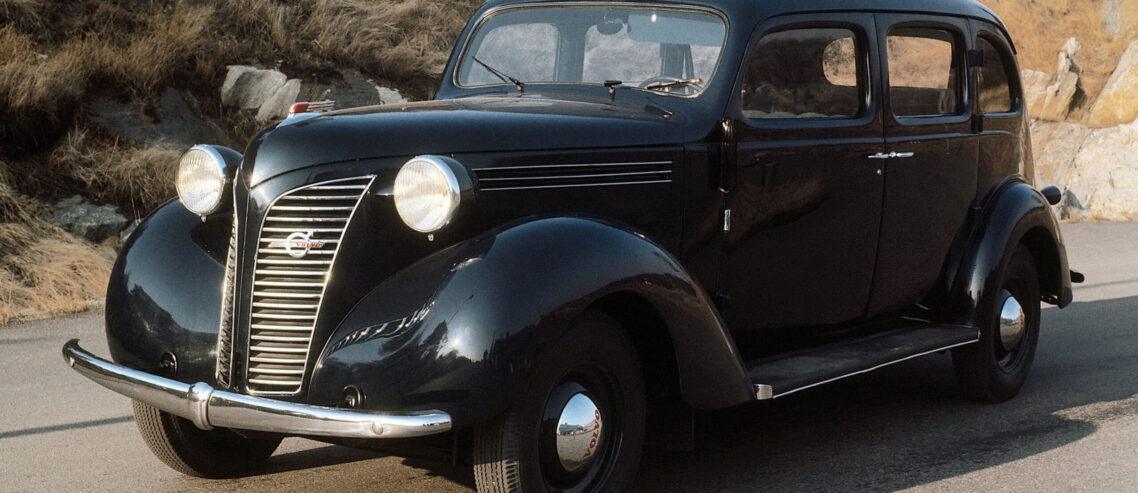
Volvo PV801–10: The Classic Swedish Taxi & Transport Car
The Volvo PV801–10 is one of the most compelling examples of Swedish automotive craftsmanship from the pre-war and post-war era. Built for demanding daily use, this remarkable model established itself as a trusted taxi and commercial transport vehicle not only across Scandinavia but throughout Europe. Robust, reliable, and purposefully designed, the PV801–10 remains a fascinating chapter in Volvo’s long and storied history — and a genuine collector’s treasure for classic car enthusiasts worldwide.
When Was the Volvo PV801–10 Built?
The Volvo PV801–10 was produced from 1938 to 1947, spanning one of the most turbulent decades in modern history. Despite the enormous challenges posed by the Second World War — material shortages, restricted trade routes, and economic uncertainty — demand for the PV801–10 remained remarkably consistent throughout its production run. This speaks volumes about the confidence that professional operators, fleet managers, and taxi companies placed in Volvo’s engineering during that period.
Sweden’s neutrality during World War II gave Volvo a unique advantage: the company could continue manufacturing vehicles while much of the European automotive industry was repurposed for wartime production. The PV801–10 benefited directly from this continuity, evolving steadily through its production years without the dramatic interruptions that plagued so many contemporaries.
The History of the Volvo PV801–10
The story of the PV801–10 begins in the late 1930s, when Volvo’s leadership recognized a growing demand for a sturdier, more versatile vehicle capable of serving both the taxi industry and the broader passenger transport market. Drawing heavily on the experience gained from the earlier TR-series (Taxi-Reihe), Volvo engineers developed a platform that was simultaneously adaptable as a formal saloon and as a light commercial carrier.
Taxicab operators across Scandinavia were particularly enthusiastic early adopters. The PV801–10 offered an unusually generous interior, a smooth and dependable drivetrain, and a build quality that could withstand the punishing wear of high-mileage professional use. In cities like Stockholm, Gothenburg, and Oslo, the PV801–10 became a fixture on the streets — an unmistakable silhouette that communicated dependability and Swedish industrial pride in equal measure.
Beyond Scandinavia, the model attracted interest from operators in other European markets who appreciated its combination of size, comfort, and mechanical simplicity. The PV801–10 was not a luxury vehicle in the traditional sense, but it delivered something arguably more valuable to its professional owners: absolute trustworthiness, day after day, kilometer after kilometer.
If you want to explore the full depth of Volvo’s pre-war heritage, an excellent starting point is this comprehensive book on classic Volvo history, which covers the development of iconic models like the PV801–10 in fascinating detail.
Who Designed the Volvo PV801–10?
The design of the PV801–10 was developed under the guidance of Gustaf Larson, one of Volvo’s two founding fathers and the company’s technical visionary during its formative years. Larson, an engineer by training and a pragmatist by temperament, consistently championed designs that balanced aesthetic coherence with functional excellence — a philosophy deeply embedded in the PV801–10’s lines and proportions.
Stylistically, the PV801–10 reflected a careful blend of European practicality and subtle American influences. During the 1930s, American automobiles — particularly those from Ford and General Motors — set many of the visual benchmarks for the global industry. Volvo’s designers interpreted these influences through a distinctly Scandinavian lens: cleaner, more restrained, with a focus on structural integrity over decorative flourish. The result was a vehicle that looked authoritative without being ostentatious — perfectly suited to its role as a professional workhorse.
The body featured a traditional three-box configuration with a long, upright nose housing the straight-six engine, a generously proportioned passenger compartment, and a squared-off rear section that maximized luggage capacity without compromising the vehicle’s overall elegance. Chrome detailing was used sparingly but effectively, lending the PV801–10 a quiet sense of occasion that distinguished it from purely utilitarian alternatives.
Engine and Drivetrain: Built to Last
The Volvo PV801–10 was powered exclusively by the proven Volvo EC engine, a straight-six petrol unit that had earned an outstanding reputation for reliability and longevity in earlier Volvo applications. For professional taxi operators who calculated the cost of ownership over hundreds of thousands of kilometers, engine durability was not a desirable bonus — it was an absolute prerequisite. The EC engine delivered on that requirement comprehensively.
Engine Specifications at a Glance
| Specification | Details |
|---|---|
| Engine Type | Straight-six petrol (inline-6) |
| Displacement | 3.67 litres |
| Power Output | approx. 86 hp at 3,600 rpm |
| Fuel System | Carburettor |
| Cooling | Water-cooled |
The EC engine’s distinguishing qualities were its smoothness at low revs, its tolerance for extended high-load operation, and its straightforward mechanical layout that allowed competent mechanics to service it with minimal specialist tooling. In an era before computerised diagnostics, this accessibility was enormously valuable — a taxi that could be repaired quickly was a taxi that was back on the road generating revenue.
Full Technical Specifications
For enthusiasts and collectors researching the Volvo PV801–10 in depth, the following table provides a consolidated overview of the model’s key technical parameters:
| Technical Parameter | Specification |
|---|---|
| Production Years | 1938–1947 |
| Body Style | Saloon / Light Commercial |
| Number of Doors | 4 |
| Seating Capacity | Up to 6 passengers (taxi configuration) |
| Engine | Volvo EC, straight-six |
| Displacement | 3,670 cc |
| Power | ~86 hp / 64 kW |
| Transmission | 3-speed manual gearbox |
| Driven Axle | Rear-wheel drive |
| Suspension (Front) | Transverse leaf spring |
| Suspension (Rear) | Semi-elliptic leaf springs |
| Brakes | Hydraulic drum brakes on all four wheels |
| Wheelbase | Approx. 3,175 mm |
| Kerb Weight | Approx. 1,700 kg |
| Top Speed | Approx. 110 km/h |
| Primary Market | Scandinavia, Northern Europe |
The PV801–10 as a Taxi: A Professional Icon
To fully appreciate the significance of the Volvo PV801–10, it is essential to understand the context in which it was designed to operate. In late 1930s Scandinavia, the taxi industry was a serious and competitive business. Operators needed vehicles that could absorb tens of thousands of kilometers per year without major mechanical failures, seat multiple passengers in genuine comfort, and project a professional image that inspired passenger confidence.
The PV801–10 fulfilled all of these requirements with distinction. Its spacious interior — accommodating up to six passengers in the taxi configuration — was a significant competitive advantage over smaller contemporaries. The rear cabin offered ample headroom and legroom, features that paying passengers noticed and appreciated. The smooth, low-vibration straight-six engine made for a quiet and composed ride quality that reinforced the sense of professional service.
Volvo’s factory also offered a degree of configurability that was unusual for the period. Operators could specify different body configurations to suit specific operational requirements — from conventional four-door saloons to more capacious people-carrier arrangements. This flexibility helped the PV801–10 find customers beyond the strict taxi sector, including hotels, private hire companies, and institutional transport operators.
Collectibility and Classic Car Status
Today, surviving examples of the Volvo PV801–10 are genuinely rare and increasingly sought after by serious collectors of pre-war and early post-war Scandinavian automobiles. The combination of its historical significance — as both a wartime survivor and a pivotal model in Volvo’s commercial vehicle lineage — and its imposing physical presence makes it a highly distinctive addition to any serious collection.
Restoration projects present both challenges and rewards. Original mechanical components, particularly EC engine parts, can be difficult to source, although the global network of Volvo classic car specialists has improved availability significantly in recent years. The bodies, typically constructed from high-quality steel with traditional coach-building techniques, are generally structurally sound if they have been properly stored, though surface corrosion is an expected challenge with any vehicle approaching 80 years of age.
For collectors interested in owning a piece of the PV801–10’s history in miniature, a beautifully crafted Volvo PV diecast scale model makes an excellent display piece and a thoughtful gift for any Volvo enthusiast.
Classic car valuations for the PV801–10 vary considerably depending on condition, provenance, and configuration. Concours-quality restored examples command significant premiums, while project vehicles offer a more accessible entry point for enthusiasts willing to invest the time and expertise in a full restoration.
Legacy and Influence on Later Volvo Models
The Volvo PV801–10 occupies an important place in the broader narrative of Volvo’s development as an automaker. The engineering lessons learned during its production — particularly regarding chassis durability, passenger space optimisation, and the commercial importance of mechanical reliability — fed directly into subsequent generations of Volvo vehicles.
The emphasis on safety and structural integrity that defines Volvo’s modern brand identity has roots in exactly the kind of thinking that shaped the PV801–10. Building a vehicle that professional drivers could trust with their livelihoods — and their passengers’ lives — was not merely a marketing consideration. It was a deeply held engineering principle that Gustaf Larson and his team embedded in the DNA of every vehicle they produced.
In this sense, the PV801–10 is not simply a historical curiosity. It is a direct ancestor of the safety-conscious, reliability-focused Volvo philosophy that resonates powerfully with drivers to this day. Understanding the PV801–10 means understanding something fundamental about what Volvo has always stood for.
For those wishing to explore this heritage in even greater depth, this authoritative book on Swedish classic car history provides outstanding context for the PV801–10’s place in automotive history.
Frequently Asked Questions About the Volvo PV801–10
What does PV stand for in the Volvo PV801–10?
PV stands for “Personvagn”, the Swedish word for passenger car. The designation was used by Volvo across a broad range of passenger vehicle models during the pre-war and post-war periods, including the famous PV444 and PV544 that followed in later decades.
How many Volvo PV801–10 units were produced?
Exact production figures for the PV801–10 are not definitively established in all historical sources, but the model is understood to have been produced in relatively limited numbers by modern standards — a factor that contributes directly to its rarity and collectibility today. The nine-year production run (1938–1947) included periods of reduced output due to wartime material constraints.
What engine did the Volvo PV801–10 use?
The PV801–10 was fitted exclusively with the Volvo EC straight-six petrol engine, displacing 3.67 litres and producing approximately 86 horsepower at 3,600 rpm. This engine was selected specifically for its proven reliability and ease of maintenance — critical considerations for the taxi and transport operators who formed the model’s primary customer base.
Was the Volvo PV801–10 used outside Sweden?
Yes. While the PV801–10 was primarily marketed in Scandinavia, particularly Sweden and Norway, examples were exported to other European markets. The model’s combination of robust construction and spacious accommodation gave it appeal wherever professional passenger transport operators valued reliability over purely sporty performance credentials.
How does the PV801–10 compare to other Volvo models of the same era?
The PV801–10 was positioned as a larger, more commercial-oriented alternative to Volvo’s standard passenger car offerings of the period. Where models like the PV51 and PV60 targeted private buyers, the PV801–10 was deliberately engineered for fleet and professional use, with emphasis on durability, interior space, and low total cost of ownership over high mileage.
Is the Volvo PV801–10 difficult to restore?
A restoration of the PV801–10 presents moderate to significant challenges, primarily related to sourcing original or compatible mechanical components and body panels. However, the Volvo classic car community is well-organised and knowledgeable, and specialist suppliers in Sweden and elsewhere have improved parts availability considerably in recent years. The straightforward mechanical design of the EC engine is a genuine advantage for restorers.
What is the Volvo PV801–10 worth today?
Values for the Volvo PV801–10 vary widely depending on condition, completeness, and provenance. Fully restored concours examples can command prices equivalent to rare pre-war saloons from other European manufacturers, while unrestored project vehicles are available at considerably lower entry points. Given the model’s rarity and growing collector interest, values have trended upward in recent years, making early acquisition a strategically sound decision for serious collectors.
Comments
Leave a Comment