
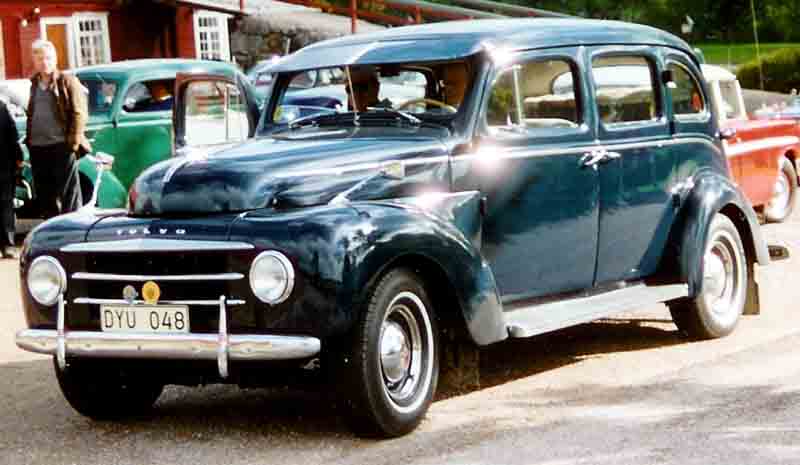
Volvo PV831 – The Classic Swedish Long-Distance Taxi
The Volvo PV831, affectionately known as the “Volvo Taxi,” stands as one of the most enduring and purposeful automobiles ever produced by the Swedish manufacturer. With its generous body dimensions, robust engineering, and exceptional reliability, the PV831 became the definitive vehicle for long-distance taxi operations and hotel limousine service across Scandinavia and beyond. This is a classic car that did not merely exist — it worked, tirelessly, often clocking over a million kilometres in commercial service. Few vehicles from any era can make that claim.
As a Volvo enthusiast with two decades of hands-on experience with Swedish classics, I can say without hesitation that the PV831 represents something rare in automotive history: a machine built not for glamour, but for absolute dependability. And in doing so, it became genuinely iconic.
Production Period of the Volvo PV831
The Volvo PV831 was produced between 1950 and 1958, a period of significant social and economic transformation across post-war Europe. Sweden, having remained neutral during the Second World War, was positioned to rebuild and modernise its infrastructure rapidly — and reliable, spacious passenger vehicles were in high demand.
Alongside the PV831, Volvo simultaneously produced the closely related PV832 sister model. Together, these two variants formed the backbone of professional passenger transport in Sweden throughout the 1950s, and they represent the final, most mature evolution of the long-running PV800 series that Volvo had introduced back in 1938.
| Model | Production Years | Primary Use |
|---|---|---|
| Volvo PV831 | 1950 – 1958 | Taxi, Hotel Limousine, Company Car |
| Volvo PV832 | 1950 – 1958 | Taxi, Private Hire, Long-Distance Transport |
| Volvo PV800 (original) | 1938 – 1950 | Private and Commercial Passenger Transport |
The History of the Volvo PV831
The story of the Volvo PV831 begins with the broader PV800 series, which Volvo launched in 1938 as a large, American-influenced passenger car aimed at professional and commercial buyers. The original PV801 and subsequent variants were well received, but it was the post-war continuation of this lineage — refined, enlarged, and re-engineered — that truly defined what the PV800 series could become.
After World War II, Swedish society needed dependable, high-capacity transport solutions. Taxi companies, hotels, and private hire operators required vehicles that could handle the demands of daily professional use: long hours, high mileage, and the need for passenger comfort on Scandinavia’s sometimes challenging road network. Volvo responded with the PV831, a stretched, refined, and mechanically improved variant that answered every one of those needs.
What made the PV831 truly remarkable was not any single feature but the combination of durability, passenger space, and mechanical simplicity. Workshop technicians loved it because it was straightforward to maintain. Drivers respected it because it never let them down. Passengers appreciated it because it offered genuine comfort for the era. In Sweden, the PV831 quickly became synonymous with professional passenger transport — a reputation built kilometre by kilometre across countless journeys.
If you are researching the full history of Volvo’s classic commercial vehicles, an excellent starting point is a dedicated Volvo classic car history book, which often covers the PV800 series in impressive detail.
Many PV831 vehicles remained in active service well into the 1970s and even beyond — a testament to a build quality that was, even by Volvo’s own high standards, exceptional. Documented examples have been verified with odometer readings exceeding one million kilometres, making the PV831 one of the most long-lived commercial vehicles of the 20th century.
Design and Styling of the Volvo PV831
The design of the Volvo PV831 was handled entirely by Volvo’s internal design team, and it drew clear inspiration from the large American automobiles of the late 1930s and 1940s. This was entirely intentional: Volvo’s leadership at the time admired the imposing proportions and structural solidity of American cars and set out to incorporate those qualities into a vehicle suited to Swedish conditions and commercial requirements.
- Long, prominent bonnet — conveying strength and mechanical substance
- Upright, vertical radiator grille — a hallmark of the era’s formal automotive design language
- Generous body proportions — allowing for a spacious, six-passenger interior
- High roofline — providing headroom appropriate for a professional taxi or limousine
- Running boards — a practical feature retained from the pre-war design tradition
- Separate front wings — characteristic of the transitional styling era between pre-war and post-war automotive design
The overall silhouette of the PV831 is unmistakably of its time, yet there is a timeless dignity to its proportions that continues to appeal to classic car enthusiasts today. It looks, quite simply, like a car that means business — and that was entirely the point.
Engine and Technical Specifications
The Volvo PV831 was powered by the Volvo EB inline six-cylinder engine, displacing 3.67 litres and producing approximately 90 horsepower. For a commercial vehicle of this size in the early 1950s, this was a well-matched and thoroughly practical powertrain — not designed for performance, but engineered for longevity and smooth, sustained operation over long distances.
Later production variants received lightly revised versions of the same fundamental engine architecture, benefiting from incremental improvements to reliability and refinement. The six-cylinder configuration was particularly valued for its smooth power delivery, making it well-suited to the demands of professional taxi driving where passenger comfort was paramount.
| Specification | Detail |
|---|---|
| Engine | Volvo EB Inline Six-Cylinder |
| Displacement | 3.67 litres (3,670 cc) |
| Power Output | Approximately 90 hp |
| Configuration | Longitudinally mounted, rear-wheel drive |
| Fuel System | Carburettor |
| Transmission | Manual gearbox |
| Body Style | Four-door saloon / limousine |
| Seating Capacity | Up to 6 passengers |
| Production Period | 1950 – 1958 |
The engine’s reputation among mechanics and operators was outstanding. It was smooth, torquey at low revs, and — crucially — simple enough to be repaired with basic workshop equipment, even in remote locations. This last quality was not a minor detail in 1950s Sweden, where long-distance routes might take a taxi driver hundreds of kilometres from the nearest major city.
The Volvo PV831 as a Professional Taxi and Hotel Limousine
It is impossible to discuss the Volvo PV831 without acknowledging the central role that professional passenger transport played in shaping its identity. In Sweden, this model became so closely associated with taxi and hotel service that many Swedes of a certain generation simply called it “the Volvo Taxi” — no further description was required.
Swedish taxi operators in the 1950s faced a demanding set of requirements. Vehicles needed to be:
- Spacious enough to accommodate multiple passengers and luggage
- Mechanically robust enough to operate in Swedish winters without failure
- Comfortable enough to justify premium hotel and airport transfer fares
- Cost-effective to maintain over many years and hundreds of thousands of kilometres
The Volvo PV831 met every single one of these criteria, and it did so with a margin of reliability that its competitors could rarely match. It was not uncommon for a single PV831 to serve a taxi company for fifteen or twenty years, with mechanical overhauls but never a fundamental failure of the vehicle’s core structure or drivetrain.
For collectors and enthusiasts who want to display a piece of this remarkable commercial history, a Volvo PV series diecast model makes an excellent addition to any classic car collection and a fitting tribute to this working-class Swedish legend.
Surviving Examples and Collectability Today
Given that the Volvo PV831 was primarily a commercial workhorse rather than a prestige automobile, surviving examples in good original condition are relatively rare. Most were worked until they could no longer be economically maintained, and comparatively few were preserved when their working lives ended. This makes well-preserved or professionally restored PV831 vehicles genuinely significant finds within the classic Volvo community.
Today, the PV831 is celebrated at Scandinavian classic car events, Swedish automotive museums, and in the collections of dedicated Volvo historians worldwide. Its story resonates because it represents something fundamental: a car that earned its place in history not through racing victories or celebrity ownership, but through sheer, dependable, day-in-day-out service to ordinary people.
For those fortunate enough to own or restore a PV831, sourcing correct period components can be a rewarding challenge. Searching for Volvo PV classic spare parts through specialist suppliers and online marketplaces has become an increasingly viable route for restorers in recent years.
Why the Volvo PV831 Still Matters
In an era dominated by ever-more complex, technology-heavy automobiles, there is something deeply satisfying about a vehicle as honest and purposeful as the Volvo PV831. It was designed to do a job, and it did that job better than almost anything else available at the time. Its longevity — both in production and in active service — is a direct reflection of Volvo’s engineering philosophy during what many consider the company’s golden era of commercial vehicle development.
For classic Volvo enthusiasts, the PV831 occupies a unique position: it is neither the most glamorous nor the most sporty car in the marque’s history, but it may well be the most important in terms of what it achieved for Volvo’s reputation as a manufacturer of genuinely reliable, long-lasting vehicles. That reputation, built in part on the PV831’s extraordinary service record, continues to define Volvo to this day.
Frequently Asked Questions about the Volvo PV831
What is the Volvo PV831?
The Volvo PV831 is a large, six-cylinder Swedish passenger car produced between 1950 and 1958. It was primarily used as a professional taxi, hotel limousine, and company car, and is widely regarded as one of the most durable commercial vehicles of its era.
How many kilometres could a Volvo PV831 cover in its lifetime?
Several documented examples of the Volvo PV831 accumulated over one million kilometres in professional taxi service, making it one of the highest-mileage commercial vehicles of the 20th century. This extraordinary durability was a direct result of Volvo’s robust engineering and the mechanical simplicity of the EB inline six-cylinder engine.
What engine did the Volvo PV831 use?
The PV831 was powered by the Volvo EB 3.67-litre inline six-cylinder engine, producing approximately 90 horsepower. The engine was known for its smooth power delivery, low-end torque, and exceptional long-term reliability — qualities that made it ideal for sustained professional use.
What is the difference between the Volvo PV831 and the PV832?
The PV831 and PV832 were closely related sister models produced simultaneously between 1950 and 1958. Both shared the same fundamental body structure, engine, and commercial focus. The differences between the two variants were primarily in interior configuration, trim specification, and certain mechanical details — both were equally suited to taxi and professional transport roles.
Is the Volvo PV831 rare today?
Yes, well-preserved examples of the Volvo PV831 are relatively rare. As a commercial vehicle, most were operated until the end of their economically viable service life, meaning comparatively few survived into the modern classic car era. Genuine, original-condition PV831 vehicles are considered significant collector pieces within the Volvo historic community.
Where was the Volvo PV831 primarily used?
The PV831 was primarily used in Sweden as a professional taxi and hotel limousine, though it also saw service in other Scandinavian countries and selected export markets. Its reputation for cold-weather reliability made it particularly well-suited to Nordic operating conditions.
How does the Volvo PV831 fit into Volvo’s classic car heritage?
The Volvo PV831 represents the mature conclusion of the PV800 series, which began in 1938. It bridges the pre-war and post-war eras of Volvo’s commercial vehicle development and is a direct predecessor to the engineering philosophy that would later produce legendary models such as the Volvo Amazon and the Volvo P1800. Understanding the PV831 is essential to understanding how Volvo built its global reputation for durability and safety.
Comments
Leave a Comment