
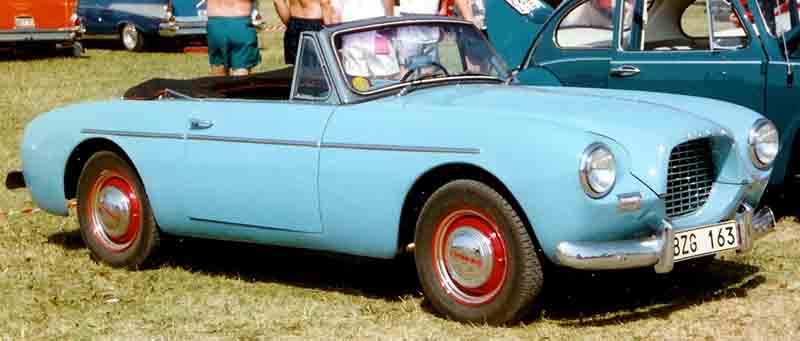
Volvo Sport P1900 – Sweden’s First Sports Car (1956–1957)
Volvo Sport P1900 – Sweden’s First Sports Car and a Bold Dream
The Volvo Sport P1900 is one of the most fascinating and underappreciated chapters in early Volvo history. It was the Swedish manufacturer’s very first sports car – a daring, forward-thinking project that combined American inspiration with Scandinavian ambition. Yet it was also a brief and ultimately troubled experiment that came to an end almost before it had truly begun. With only 68 examples ever produced between 1956 and 1957, the P1900 remains one of the rarest and most collectible Volvos ever built.
For anyone passionate about classic Volvo automobiles, the P1900 is not merely a footnote – it is proof that Volvo once had genuine sporting aspirations, and that even a bold dream can leave a lasting legacy.
Production Period of the Volvo Sport P1900
- Production years: 1956–1957
- Total units produced: approximately 68 vehicles
- Body style: Open two-seat roadster with fiberglass (GRP) bodywork
- Market: Primarily targeted at the North American sports car segment
The extremely limited production run makes the Volvo P1900 exceptionally rare today. Finding a surviving example in good condition is a true event in the classic car world, and those that do appear at auction or in specialist collections command serious attention from Volvo historians and collectors alike.
The History of the Volvo Sport P1900
The story of the P1900 begins in the early 1950s, when Assar Gabrielsson, one of Volvo’s co-founders, visited the United States and was captivated by what he saw in the American automotive market. Light, stylish, open-top sports cars were becoming enormously popular – most notably the Chevrolet Corvette, which had been introduced in 1953 and was generating enormous public enthusiasm.
Gabrielsson recognised an opportunity. If Volvo could offer a similarly styled, lightweight sports roadster, it might appeal to younger American buyers and open up an entirely new market segment for the Swedish brand. The concept was simple: a sleek, open two-seater with a modern fiberglass body, sporty proportions, and enough performance to compete with American and European rivals.
Development began with considerable energy. Volvo partnered with the American company Glasspar – a specialist in fiberglass boat and body construction that had already collaborated on early Corvette body production – to realise the innovative GRP (glass-reinforced plastic) bodywork. This was a genuinely modern and bold material choice for a European manufacturer at that time.
However, the challenges quickly became apparent. The fiberglass body, while lightweight and visually appealing, proved to be structurally problematic. The chassis lacked the necessary rigidity, and the overall build quality fell short of what was required for the rough and demanding conditions of Scandinavian roads. Vibration, flex, and reliability concerns began to overshadow the project.
The decisive moment came when Gunnar Engellau, who succeeded Gabrielsson as Volvo’s managing director in 1956, personally test-drove the P1900. His assessment was unambiguous: the car was not good enough. Following a deeply disappointing test drive, Engellau ordered the project to be wound down. Production was halted after just 68 cars had been completed, making the P1900 one of the shortest-lived models in Volvo’s entire production history.
Ironically, Engellau’s determination to build a proper sports car did not die with the P1900 – it was redirected. His focus shifted toward the development of the far more successful Volvo P1800, which would go on to become one of Volvo’s most iconic and beloved models, later made famous by Roger Moore in the television series The Saint.
If you want to explore Volvo’s full sporting history in depth, a comprehensive book on Volvo’s classic car heritage makes an excellent starting point for any enthusiast’s library.
Design and Styling of the Volvo P1900
The design of the Volvo Sport P1900 was developed internally at Volvo, drawing clear inspiration from the American roadster aesthetic that was so fashionable during the early 1950s. The low, flowing lines, the open cockpit, and the absence of a fixed roof all contributed to a sporty and optimistic visual character that was quite unlike anything else Volvo had produced before.
The most technically distinctive feature was undoubtedly the fiberglass (GRP) bodywork, realised in partnership with Glasspar. At a time when steel was still the dominant material in automotive manufacturing, using glass-reinforced plastic for a production car body was genuinely innovative. It kept the overall weight low and allowed for more complex and curvaceous body shapes than traditional steel pressing would have permitted.
The interior was relatively simple, as befitting a sports car of that era, with a driver-focused cockpit, basic instrumentation, and a soft convertible top. The overall aesthetic was clean and uncluttered – quintessentially 1950s in character, yet with a freshness that set it apart from Volvo’s more conservative passenger car designs of the same period.
For collectors and scale model enthusiasts, a Volvo P1900 diecast model is one of the finest ways to appreciate the proportions and design details of this rare Swedish classic up close.
Technical Specifications of the Volvo Sport P1900
| Specification | Details |
|---|---|
| Production period | 1956–1957 |
| Total units produced | ~68 vehicles |
| Body style | Open 2-seat roadster (convertible) |
| Body material | Fiberglass / GRP (Glass-Reinforced Plastic) |
| Engine type | Inline four-cylinder (B16B) |
| Engine displacement | 1,583 cc |
| Power output | 70 hp (52 kW) |
| Top speed | approx. 160 km/h (100 mph) |
| Transmission | 3-speed manual gearbox |
| Drive | Rear-wheel drive |
| Suspension (front) | Independent coil spring |
| Suspension (rear) | Rigid axle with coil springs |
| Kerb weight | approx. 960 kg |
| Designed by | Volvo (in-house), with Glasspar (USA) for bodywork |
Engine and Performance
Under the hood, the Volvo Sport P1900 was powered by the B16B inline four-cylinder engine – a unit that Volvo had developed for its passenger car range. Displacing 1,583 cc, it produced 70 horsepower (52 kW), which was a meaningful upgrade over the standard B16A unit used in the PV444 and Amazon models of the same era.
The twin SU carburetors fitted to the B16B helped improve throttle response and power delivery, giving the P1900 a more sporting character. With a kerb weight of approximately 960 kg, the car had a reasonable power-to-weight ratio for its time, enabling a top speed in the region of 160 km/h (approximately 100 mph).
In the context of 1950s sports cars, these were respectable – if not exceptional – figures. The Corvette, for comparison, offered considerably more power in its V8 form. However, the P1900 was never intended to be an outright performance car in that sense; it was conceived as a stylish, lightweight roadster with enough sporting feel to appeal to the growing enthusiast market.
The three-speed manual gearbox and rear-wheel-drive layout contributed to an involving driving experience, at least in principle. In practice, as Gunnar Engellau discovered, the structural weaknesses of the body and chassis significantly undermined the driving pleasure that the specification suggested was possible.
Why Did Volvo Stop Producing the P1900?
The reasons for the P1900’s early end are well documented and straightforward. The fiberglass body, innovative as it was, introduced significant structural challenges. The car exhibited excessive flexing and vibration over uneven surfaces, which was a serious concern given that Scandinavian roads of the 1950s were frequently rough and unprepared.
Quality control during the limited production run was inconsistent, and the car’s overall refinement did not meet the standards that Volvo needed to maintain its reputation for reliability and durability. When the newly appointed managing director Gunnar Engellau drove the car himself and found it wanting, the decision to discontinue production was made without hesitation.
It was not a lack of ambition that ended the P1900 – quite the opposite. Volvo’s leadership recognised that launching an underperforming sports car in the highly competitive American market could seriously damage the brand’s credibility. Better to stop, learn, and try again properly. That second attempt would come in the form of the far more accomplished Volvo P1800.
The Legacy of the Volvo Sport P1900
Despite its brief production life, the Volvo P1900 occupies a unique and important place in Volvo’s history. It was the first tangible expression of the company’s desire to build something more exciting than practical family saloons and estate cars. It demonstrated that Volvo’s engineers and designers were willing to explore new materials, new markets, and new vehicle concepts.
The lessons learned from the P1900’s shortcomings directly informed the development of the Volvo P1800, which debuted in 1961 and went on to become one of the most successful and beloved sports coupes in Volvo’s history. In that sense, the P1900 was not a failure – it was a necessary step on the road to something great.
Today, surviving P1900 examples are extraordinarily rare and are prized by serious Volvo collectors worldwide. They appear occasionally at major classic car events and auction houses, always attracting admiring attention from those who appreciate just how unusual and historically significant they are.
For those who own or are restoring a surviving P1900 or related early Volvo, sourcing the right components is essential. Specialist suppliers offer classic Volvo spare parts and restoration components that can assist in keeping these irreplaceable vehicles alive for future generations.
Volvo P1900 vs. Chevrolet Corvette – A Brief Comparison
| Feature | Volvo Sport P1900 | Chevrolet Corvette (C1) |
|---|---|---|
| Production years | 1956–1957 | 1953–1962 |
| Units produced | ~68 | ~70,000+ |
| Engine | 1.6L inline-four, 70 hp | V8 options, up to 290+ hp |
| Body material | Fiberglass (GRP) | Fiberglass (GRP) |
| Origin | Sweden | United States |
| Target market | USA (primarily) | USA |
The comparison illustrates both the ambition and the limitations of the P1900. In terms of power and scale, the Corvette operated in a different league entirely. But the P1900’s significance lies not in competing with the Corvette – it lies in what it represented for Volvo as a brand taking its first sporting steps.
Frequently Asked Questions About the Volvo Sport P1900
How many Volvo P1900 cars were produced?
Only approximately 68 examples of the Volvo Sport P1900 were produced during its short production run from 1956 to 1957. This makes it one of the rarest Volvo models ever built and among the most collectible classic Swedish cars in existence.
Why was the Volvo P1900 discontinued so quickly?
The P1900 was discontinued primarily because of structural and quality issues with the fiberglass body. The car was deemed insufficiently robust for Scandinavian road conditions. After Volvo’s new managing director Gunnar Engellau personally test-drove the vehicle and found it unsatisfactory, he ordered an end to production in 1957.
What engine did the Volvo Sport P1900 use?
The P1900 was powered by Volvo’s B16B inline four-cylinder engine, displacing 1,583 cc and producing 70 horsepower (52 kW). It was fitted with twin SU carburetors and mated to a three-speed manual gearbox.
Who designed the Volvo P1900?
The design was developed in-house at Volvo, drawing inspiration from contemporary American roadster styling. The innovative fiberglass bodywork was produced in collaboration with the American company Glasspar, which had prior experience with GRP body construction.
Is the Volvo P1900 related to the Volvo P1800?
The P1900 and P1800 are not directly related mechanically, but they are historically connected. The lessons learned from the P1900’s shortcomings directly contributed to the development approach taken for the P1800, which launched in 1961 and became one of Volvo’s most iconic models.
What is a Volvo P1900 worth today?
Due to their extreme rarity, surviving Volvo P1900 examples are highly valuable. While precise values depend heavily on condition and provenance, well-preserved or restored examples have been known to command prices well into the six-figure range at specialist classic car auctions. They are considered significant collector pieces by Volvo historians worldwide.
Where can I see a Volvo P1900 today?
A small number of surviving P1900 cars can be found in private collections and specialist Volvo museums. The Volvo Museum in Gothenburg, Sweden is one of the best places to see Volvo’s full historical range, including rare models such as the P1900. Occasionally, surviving examples also appear at major classic car shows and concours events across Europe and North America.
Comments
Leave a Comment