
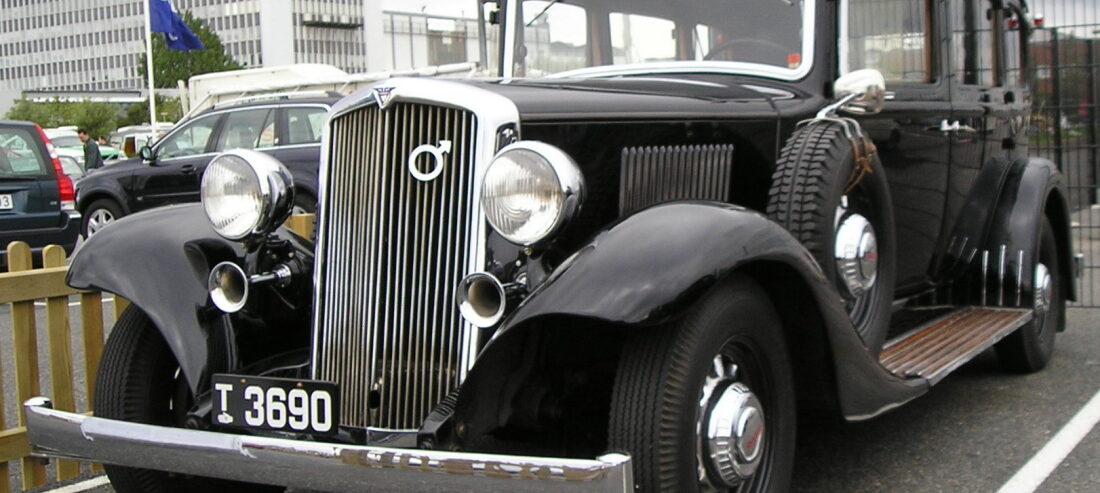
Volvo TR701: Sweden’s First Purpose-Built Taxi (1934–35)
The Volvo TR701 holds a very special place in automotive history – not just within the Volvo story, but in the broader narrative of professional passenger transport in Scandinavia. Built between 1934 and 1935, it was the first Volvo model purpose-engineered for the taxi and hotel transfer market, setting the foundation for an entirely new model family that would carry the Swedish marque through the following decade. As someone who has spent over twenty years studying and driving classic Volvos across Europe, I find the TR701 endlessly fascinating: it represents Volvo at its most pragmatic, most purposeful, and, in its own understated way, most visionary.
What Is the Volvo TR701?
The Volvo TR701 was the inaugural model in Volvo’s so-called TR series – derived from the Swedish word Trafikvagn, meaning roughly “traffic car” or “transport vehicle.” In practical terms, this designation referred to a range of specially configured Volvo saloons and limousines built for professional use: taxis, hotel courtesy cars, and chauffeured transport services. The TR701 launched this tradition in 1934 and remained in production until 1935, with a relatively small but historically significant production run.
At its core, the TR701 was a stretched and strengthened version of the Volvo PV653, one of the standard passenger models of the era. However, Volvo’s engineers made several deliberate modifications to adapt the platform for demanding commercial use: a longer wheelbase, a reinforced body structure, greater passenger capacity, and enhanced durability in key mechanical components. The result was a vehicle that could comfortably carry up to six passengers while delivering the reliability that professional operators depended upon day in and day out.
If you are passionate about this era of Swedish automotive history, you may enjoy exploring books on classic Volvo history available on Amazon, which often cover the TR series in excellent detail.
Production Years and Historical Context
The Volvo TR701 was manufactured from 1934 to 1935. To understand why Volvo chose this particular moment to enter the taxi market, it helps to consider the broader economic and social climate of 1930s Sweden. Urbanisation was accelerating, motorised public transport was rapidly displacing horse-drawn carriages, and the hospitality industry – hotels, railway connections, and tourist services – was growing quickly. Taxi operators needed vehicles that were not merely reliable, but also spacious, presentable, and economical to maintain. Volvo identified this gap and responded with a product that was precisely engineered to fill it.
The TR701 was not produced in enormous numbers – exact production figures are difficult to verify due to limited surviving factory records from this period – but its cultural and strategic impact far outweighed its production volume. It proved that Volvo could serve professional markets with equal or greater competence than its passenger car counterparts, and it opened the door for a succession of TR models throughout the late 1930s and into the 1940s.
Design and Styling: Function Over Fashion
The aesthetic of the Volvo TR701 was shaped under the direction of Gustaf Larson, one of the two co-founders of Volvo alongside Assar Gabrielsson. Larson, an engineer by training, approached automotive design from a deeply functional perspective, and this philosophy is clearly visible in every line of the TR701. There are no superfluous flourishes, no attempt to follow the more flamboyant styling currents emerging from American coachbuilders of the same era. Instead, the TR701 presents itself with quiet authority: a commanding upright radiator grille, pronounced freestanding front mudguards (fenders), a long and substantial body profile, and a well-proportioned roofline that allowed genuine headroom for rear passengers.
The overall aesthetic draws heavily from American automotive design conventions of the late 1920s and early 1930s – a deliberate choice, since American cars of this period set the global benchmark for size, comfort, and prestige in the eyes of professional transport operators. Yet the TR701 also reflects a distinctly Scandinavian restraint: nothing ostentatious, nothing fragile, nothing that could not be repaired by a competent mechanic in a provincial Swedish workshop. This practical elegance would go on to become a hallmark of the entire Volvo brand identity.
Technical Specifications of the Volvo TR701
Below is a comprehensive overview of the key technical data for the Volvo TR701, based on available historical documentation and period specifications:
| Specification | Detail |
|---|---|
| Production Years | 1934 – 1935 |
| Body Style | Six-seater saloon / limousine (taxi configuration) |
| Wheelbase | 3,100 mm (extended vs. standard PV653) |
| Engine Type | Inline six-cylinder (Type EB) |
| Engine Displacement | 3,366 cc |
| Power Output | Approximately 65 hp at 3,200 rpm |
| Fuel System | Carburettor (downdraft type) |
| Transmission | Three-speed manual gearbox |
| Passenger Capacity | Up to 6 passengers |
| Base Platform | Volvo PV653 |
| Market Segment | Professional taxi and hotel transport |
The Engine: Volvo’s Reliable EB Six-Cylinder
At the heart of the TR701 sat Volvo’s Type EB inline six-cylinder engine – a unit that had already proven itself in the standard PV-series passenger cars and was well-regarded for its smooth power delivery and durability under sustained use. For a taxi operator running a vehicle for ten, twelve, or more hours per day, engine reliability was not merely desirable – it was existential. A broken-down taxi meant lost income, and commercial buyers had little patience for mechanically adventurous engineering. The EB unit delivered exactly what they needed.
Key engine characteristics included:
- Configuration: Inline six-cylinder, water-cooled
- Displacement: 3,366 cc
- Maximum power: Approximately 65 horsepower at 3,200 rpm
- Fuel delivery: Downdraft carburettor
- Ignition: Conventional coil ignition system
- Cooling: Liquid-cooled with front-mounted radiator
Sixty-five horsepower may sound modest by contemporary standards, but for a vehicle of this size and weight in the mid-1930s, it provided more than adequate performance. The engine’s torque characteristics – typical of large-displacement six-cylinder units of this era – meant the TR701 could pull away smoothly from a standstill even when fully loaded, a quality that taxi drivers and their passengers would have appreciated enormously on the steep hills of cities like Gothenburg or Stockholm.
The TR701’s Role in Volvo’s Commercial Strategy
It is worth stepping back to appreciate just how strategically important the TR701 was for Volvo as a company. In 1934, Volvo was still a relatively young manufacturer – the company had only been founded in 1927 – and was working hard to establish credibility in multiple market segments simultaneously. The decision to develop a dedicated taxi model was not simply a response to market demand; it was a deliberate statement of intent. By serving professional operators – people who made their living from their vehicles and therefore demanded the very highest standards of reliability and longevity – Volvo was putting its engineering credentials to the ultimate test.
The TR701 passed that test convincingly. Reports from Swedish taxi operators of the era indicate strong satisfaction with the vehicle’s durability and ease of maintenance. This positive reception directly encouraged Volvo to continue and expand the TR series, leading to subsequent models such as the TR702, TR703, and TR704, each incorporating incremental improvements while retaining the fundamental formula established by the TR701.
For collectors and enthusiasts interested in this era of commercial Volvo history, vintage Volvo diecast models from the 1930s are occasionally available on Amazon and make a wonderful addition to any classic car collection.
Surviving Examples and Collectability
Given its limited production run and the hard working life typically led by commercial vehicles, surviving Volvo TR701 examples are extremely rare today. Unlike privately owned passenger cars, which were often garaged and maintained with sentimental care, taxis were driven hard, serviced utilitarian, and frequently retired without much ceremony. Many TR701 bodies were scrapped once the vehicles became uneconomical to run, and wartime metal shortages in the early 1940s claimed additional examples.
Those TR701 vehicles that do survive – primarily in Scandinavian museums and private collections in Sweden and Norway – are considered highly significant artefacts of 1930s automotive and social history. They are not merely old cars; they are tangible links to a specific moment in Swedish commercial life, when motorised transport was transforming urban economies and Volvo was finding its identity as a manufacturer of vehicles built to endure.
If you would like to explore the wider story of Volvo’s pre-war models in greater depth, a dedicated book on pre-war Volvo automobiles is an excellent starting point and a rewarding read for any serious enthusiast.
The Legacy of the Volvo TR701
The TR701’s legacy extends well beyond its two-year production run. By establishing a dedicated commercial passenger transport model within the Volvo lineup, it created a template that the company would return to repeatedly over the following decades. The logic of taking a proven passenger car platform, extending it, strengthening it, and configuring it specifically for professional use became a recurring formula in Volvo’s product development history – one that can be traced in spirit all the way through to the Volvo 240-based taxis of the 1980s and the professional-spec Volvo V90 estate cars used by taxi operators across Scandinavia today.
Perhaps more importantly, the TR701 helped establish Volvo’s reputation for building cars that last. In the harsh economic climate of the 1930s, where every kilometre of commercial operation had to pay its way, the TR701’s durability was not merely a selling point – it was a survival requirement. That Volvo met this requirement so effectively in 1934 tells us a great deal about the engineering culture that would go on to make the brand one of the most trusted automotive names in the world.
Frequently Asked Questions About the Volvo TR701
What does TR stand for in Volvo TR701?
TR stands for Trafikvagn, a Swedish term meaning “traffic car” or “transport vehicle.” This designation identified Volvo’s dedicated taxi and professional passenger transport models, distinguishing them from standard private-use passenger cars in the company’s lineup.
How many passengers could the Volvo TR701 carry?
The Volvo TR701 was designed to carry up to six passengers, made possible by its extended wheelbase of 3,100 mm, which provided significantly more interior space than the standard PV653 on which it was based.
What engine did the Volvo TR701 use?
The TR701 was powered by Volvo’s Type EB inline six-cylinder engine with a displacement of 3,366 cc, producing approximately 65 horsepower at 3,200 rpm. Fuel was delivered via a downdraft carburettor, and the engine was well-regarded for its reliability under sustained commercial use.
Is the Volvo TR701 related to the Volvo PV653?
Yes. The TR701 was directly based on the Volvo PV653 platform, but with a lengthened wheelbase, a reinforced body structure, and modifications specifically tailored for professional taxi service. It was not simply a rebadged PV653 but a meaningfully re-engineered derivative.
How many Volvo TR701 cars were built?
Exact production figures are not precisely documented in publicly available records, but the TR701 was produced in relatively small numbers during its two-year production run from 1934 to 1935. Surviving examples are extremely rare and are primarily found in Scandinavian museum collections.
Who designed the Volvo TR701?
The TR701’s design was developed under the direction of Gustaf Larson, one of Volvo’s two co-founders. Larson’s engineering background informed a design philosophy that prioritised function, durability, and practicality over stylistic novelty, resulting in a vehicle that was conservative in appearance but thoroughly fit for purpose.
Why is the Volvo TR701 historically significant?
The TR701 is historically significant because it was Volvo’s first purpose-built taxi model and the founding vehicle of the entire TR series. It demonstrated that Volvo could successfully serve professional commercial operators, helped establish the brand’s reputation for durability and reliability, and created a product development template that influenced Volvo’s commercial vehicle strategy for decades to come.
Comments
Leave a Comment